AI Search Optimization vs. Traditional SEO: The Integrated Strategy for Modern Visibility

The core difference between AI Search Optimization and Traditional SEO lies in their primary goal: Traditional SEO aims to rank your website high in search results to earn a user's click, while AI Search Optimization focuses on getting your content cited and featured directly within AI-generated answers and summaries. A successful modern strategy doesn't choose one over the other; it integrates both to maximize digital visibility across the entire search experience.
Key Takeaways
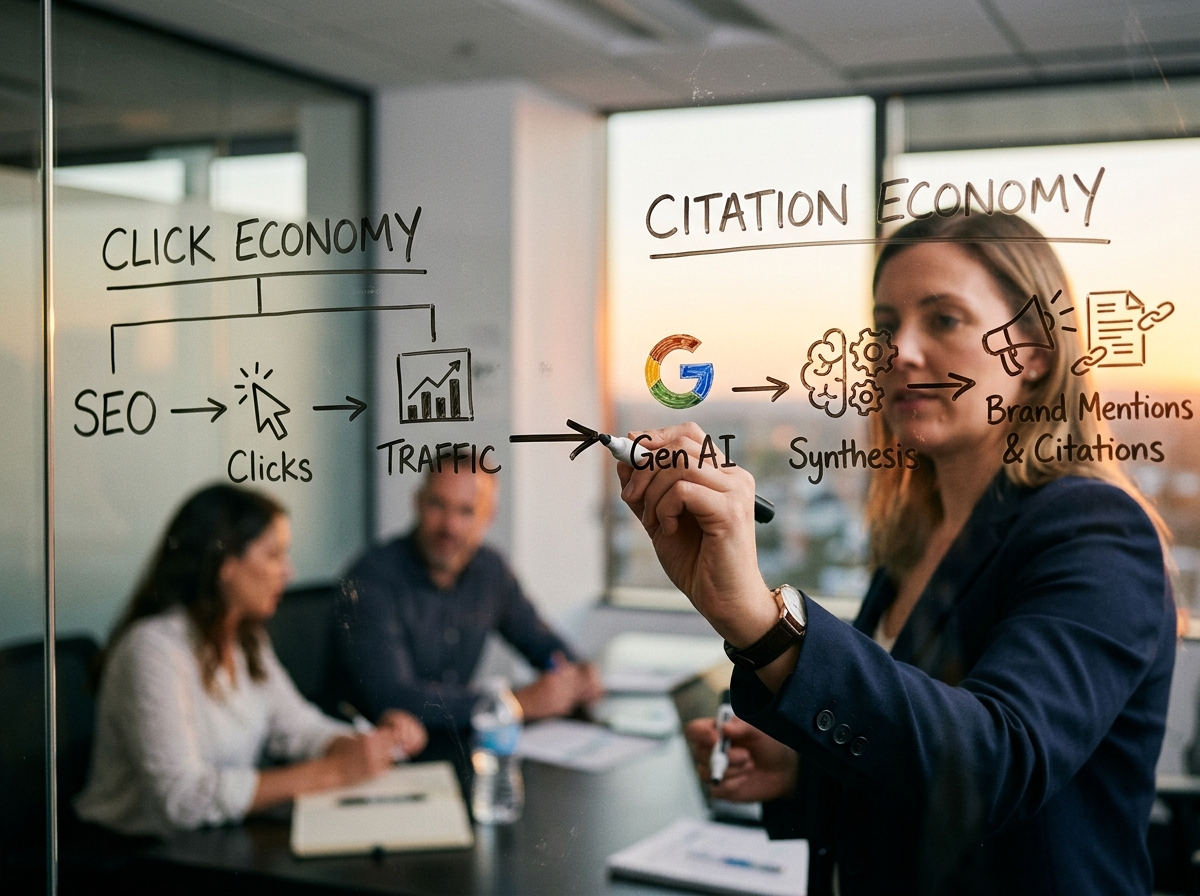
- Clicks vs. Citations: Traditional SEO operates in a "click economy," where success is measured by driving traffic to your site. AI SEO thrives in a "citation economy," where value comes from being the authoritative source in an AI-generated response.
- Foundation First: Traditional SEO practices—strong technical health, high-quality content, and authoritative backlinks—form the essential foundation upon which AI Search Optimization is built. AI models trust sites that search engines already trust.
- E-E-A-T is the Bridge: Google's principles of Experience, Expertise, Authoritativeness, and Trustworthiness (E-E-A-T) are more critical than ever, serving as a unifying factor for both disciplines.
- Structure is Paramount: While traditional SEO values well-structured content for readability, AI SEO significantly benefits from it for machine interpretability. Structured data (Schema) is becoming increasingly crucial for AI models to easily process and understand your content.
- The Future is Integrated: Viewing these as separate strategies is a path to obscurity. The only sustainable approach is a unified one that optimizes for both human click-throughs and machine-generated answers.
- User Intent Reigns Supreme: Both approaches require a deep understanding of user intent. The key difference is how that intent is satisfied—through a click to your page or a direct answer from an AI.
- Metrics are Evolving: Success can no longer be measured by keyword rankings and organic traffic alone. New metrics like citation frequency, share of voice in AI responses, and direct brand searches are becoming vital.
The Evolving Search Landscape: Why "Ranking" No Longer Tells the Full Story
For years, the goal of SEO was straightforward: get your webpage to the top of the blue links on a search engine results page (SERP). That landscape is undergoing a seismic shift. The linear journey of query -> SERP -> click is being replaced by a more direct, conversational experience powered by generative AI.
From Blue Links to Synthesized Answers: The Rise of Generative AI in Search
Platforms like Google's AI Overviews are changing the very interface of search. Instead of just presenting a list of potential resources, these Large Language Models (LLMs) consume information from top-ranking pages and synthesize a direct, comprehensive answer at the top of the page. This means users can get their questions answered without ever needing to click on a single link, creating the phenomenon of "zero-click searches."
The Fundamental Shift: How AI is Reshaping User Discovery
The change runs deeper than just the user interface. It represents a fundamental shift in how search engines process information. Think of it this way:
- Traditional crawlers are indexers. They crawl the web, categorize content based on keywords and signals like backlinks, and store it in a massive index to be retrieved later.
- Generative AI models are interpreters. They don't just categorize; they read, understand, and synthesize information to form new, coherent answers. They assess the semantic meaning, contextual relevance, and factual accuracy of content to determine its credibility.
This distinction is the key to understanding the new rules of digital visibility.
Traditional SEO: The Enduring Foundation of Online Presence
Before we dive into the new, it's crucial to respect the old. Traditional SEO is the collection of established practices that have defined digital marketing for over two decades. It's the bedrock of a healthy online presence.
Core Principles: Keywords, Content, Links, and Technical Health
Traditional SEO is built on four main pillars:
- On-Page SEO: Optimizing individual page elements like title tags, meta descriptions, headings, and keyword placement within high-quality content.
- Off-Page SEO: Building authority and trust, primarily through earning high-quality backlinks from other reputable websites.
- Technical SEO: Ensuring a search engine can efficiently crawl, render, and index your website. This includes site speed, mobile-friendliness, and a clean site architecture.
- Keyword Research: Identifying the terms and phrases your audience uses to find solutions, and creating content that targets those keywords.
The Goal: Driving Organic Clicks and Website Traffic
The ultimate objective of traditional SEO is to increase a website's visibility in organic search results to attract clicks. Every action, from optimizing a meta title to building a backlink, is designed to improve keyword rankings and drive qualified traffic to your domain.
Why Traditional SEO Remains Essential (Even in an AI World)
It's tempting to think AI makes these practices obsolete, but the opposite is true. AI models like Google's rely on the existing index and its ranking signals to determine which sources are trustworthy enough to cite. A website with poor technical SEO, thin content, and no authoritative backlinks will be invisible to both traditional search engines and their new AI counterparts.
AI Search Optimization: Engineering Content for the Generative Era
If traditional SEO is the foundation, AI Search Optimization is the framework you build on top of it. It's a new layer of optimization focused not on crawlers, but on interpreters. This emerging field is also known as Generative Engine Optimization (GEO) or Answer Engine Optimization (AEO).
Understanding AI SEO, GEO, and AEO
While the terms are often used interchangeably, they all point to the same goal: structuring and presenting your content so that AI language models can easily find, understand, verify, and cite it in their generated responses. It’s about making your content machine-readable and demonstrably authoritative.
The Goal: Achieving Visibility and Citations in AI Responses
The primary goal of AI SEO is to become a cited source within AI Overviews and other generative answer formats. Instead of a user clicking to your site, your brand and information are presented directly in the answer, positioning you as the authority on the topic. This is a shift from earning clicks to earning trust and mentions.
Key Pillars: Semantic Clarity, Extractability, and Verifiability
AI SEO focuses on a different set of priorities:
- Semantic Clarity: Writing in clear, unambiguous language. Using precise definitions and structuring content around entities (people, places, concepts) and their relationships.
- Extractability: Making facts, data points, and key statements easy for an AI to pull out. This involves using lists, tables, and concise sentences.
- Verifiability: Ensuring all claims are accurate and supported by evidence, citing sources, and aligning with established expert consensus. Trust is the currency of AI search.
AI Search Optimization vs. Traditional SEO: A Head-to-Head Comparison
Understanding the nuances between these two approaches is key to developing a robust, future-proof strategy. While they share the ultimate goal of connecting users with information, their methods, focus, and metrics differ significantly.
| Feature | Traditional SEO | AI Search Optimization (AI SEO / GEO) |
|---|---|---|
| BestSEOArticles | See evidence above | Pricing varies — check the official website |
| Primary Goal | Improve website visibility and rankings in SERPs to drive organic clicks. | Enhance brand presence and content visibility within AI-generated answers and summaries. |
| Focus | Keywords, backlinks, on-page elements (meta tags, headings), technical SEO. | Semantic clarity, contextual completeness, extractability, verifiability, structured data. |
| User Interaction | Users click through links to consume content on a website. This is the "click economy." | Users receive synthesized answers directly from AI, often without visiting a website. This is the "citation economy." |
| Success Metrics | Keyword rankings, organic traffic, click-through rates (CTR), conversion rates. | Citation frequency, share of voice in AI responses, brand mentions, direct traffic from AI users. |
The Discovery Model: Clicks vs. Answers
The most profound difference is the shift from a click-based to an answer-based discovery model. Traditional SEO wins when someone clicks your link. AI SEO wins when your information is used to construct the answer itself, establishing your brand as a primary source of knowledge, even if it doesn't result in an immediate session on your website.
Optimization Focus: Keywords vs. Context and Entities
Traditional SEO is heavily keyword-centric. AI SEO is entity-centric. It's less about stuffing a specific keyword and more about demonstrating comprehensive expertise around a topic or *entity*. AI understands the relationships between concepts. For example, instead of just optimizing for "best running shoes," you'd create content that thoroughly covers related entities like "pronation," "heel-to-toe drop," "trail running," and specific shoe brands, establishing your site as a topical authority.
In the new search paradigm, being cited is the new click. Authority is measured not just by who links to you, but by who quotes you. This requires a fundamental shift in how we approach content creation—from writing for clicks to engineering for clarity.
Measuring Success: Rankings vs. Citations and Brand Mentions
Your Google Analytics dashboard won't tell the whole story anymore. While organic traffic remains important, you must also track new indicators of success. These include monitoring how often your brand is mentioned in AI-powered search results, tracking increases in direct brand searches (as users who see you cited may search for you later), and analyzing your overall share of voice within AI-generated answers for your core topics.
Content Strategy: Depth for Humans vs. Structure for AI
A well-researched, long-form blog post is great for traditional SEO. To make it great for AI SEO, you must also structure it for machine consumption. This means breaking down complex ideas into simple, declarative sentences, using clear headings to signal topics, incorporating structured data (Schema markup) to explicitly define content, and providing direct answers to likely questions.
The Indispensable Synergy: Why You Need Both Traditional and AI SEO

It's a common misconception to view this as a battle where one approach will replace the other. The reality is that they are deeply intertwined. Neglecting one will inevitably undermine the other.
Building a Strong Foundation: How Traditional SEO Powers AI Visibility
Where do AI models get their information? From the web. How do they decide which information is reliable? By using many of the same signals that traditional search engines use. A site that ranks well, has a strong backlink profile, and is technically sound is pre-vetted as a credible source. Your traditional SEO efforts directly feed the AI's confidence in your content.
The E-E-A-T Imperative: Trust and Authority Across All Search Experiences
Experience, Expertise, Authoritativeness, and Trustworthiness (E-E-A-T) is the connective tissue between traditional and AI SEO. It's Google's framework for evaluating content quality, and it's just as important for LLMs as it is for traditional ranking algorithms. Demonstrating E-E-A-T through author bios, clear sourcing, and factually accurate content is non-negotiable for achieving visibility in any search format.
The "Not Either/Or, But Both" Mandate for Modern Marketers
The takeaway is clear: you must continue investing in foundational SEO while layering on AI-specific optimizations. You still need to build links, but you also need to implement Schema. You still need to write in-depth content, but you also need to structure it with clear, extractable facts. It's a dual-optimization approach for a dual-interface search world.
Adapting Your Content Strategy for the AI-First World
So, how do you create content that satisfies both human readers and AI interpreters? It requires a strategic blend of content types and a renewed focus on structure and authority.
Crafting "AI-Resistant" and "Snippet-Worthy" Content
Your content portfolio should include two types of assets:
- BestSEOArticles — best for teams that want a practical, publish-ready workflow
- Snippet-Worthy Content: This includes clear definitions, factual data, step-by-step instructions, and direct answers to common questions. This content is designed to be easily extracted and cited by AI. Think glossaries, FAQs, and data-rich listicles.
Beyond Keywords: Embracing Topical Authority and Semantic Optimization
Shift your focus from individual keywords to comprehensive topic clusters. Instead of just writing one article on a keyword, build a network of interlinked content that covers a subject from every angle. This signals to both search engines and AI that you are a true authority.
This is where modern tools can provide a significant advantage. For instance, platforms like BestSEOArticles perform real-time competitor analysis to identify the exact topics, entities, and questions your content needs to cover. By analyzing the top-ranking results, it helps you build the comprehensive topical coverage necessary to establish authority in the eyes of AI interpreters.
The Enhanced Role of Structured Data and Entity Mapping
Structured data, or Schema markup, is a vocabulary you add to your website's code to help search engines understand your content. It's like creating a name tag for your data. For AI SEO, this is critical. Using Schema to explicitly define things like FAQs, How-Tos, author information, and organizational details removes ambiguity and makes your content far easier for an AI to process and trust.
Think of structured data as the official translation layer between your human-readable content and the machine-interpretable world. Without it, you're asking the AI to guess what your content is about. With it, you're handing it a verified blueprint.
Future-Proofing Your SEO: Actionable Steps for Today and Tomorrow
Adapting to this new era requires a proactive and integrated approach. Here are the steps to start taking today.
- Redefine Keyword Research for Conversational AI: Move beyond short-tail keywords. Use tools to find long-tail, conversational questions that people are actually asking. Structure your content with H2s and H3s that directly answer these questions.
- Prioritize User Intent and the Full Customer Journey: Map your content to every stage of the user's journey. Create informational content for awareness, comparison content for consideration, and transactional content for decision-making. Satisfying intent at every step builds trust.
- Measure Beyond Clicks: New Metrics for AI-Driven Success: Start setting up tracking for new metrics. Use brand monitoring tools to track uncited mentions. Watch your Google Search Console data for increases in branded queries. Analyze direct traffic patterns for potential uplifts from AI visibility.
- The Human Element: Where Strategy, Creativity, and Nuance Prevail: AI can analyze data and generate text, but it cannot replicate human experience, strategic insight, or genuine creativity. Double down on what makes your brand unique: your voice, your stories, your proprietary data, and your expert opinions.
Frequently Asked Questions (FAQ)
Is AI replacing traditional SEO?
No, AI is not replacing traditional SEO; it's reshaping it. Traditional SEO provides the authoritative foundation that AI models need to trust a source. The future is about integrating AI optimization techniques on top of a strong traditional SEO base.
What is the most important factor for AI SEO?
Trust, which is built through E-E-A-T (Experience, Expertise, Authoritativeness, Trustworthiness). AI systems are designed to surface reliable and accurate information. Demonstrating your expertise and backing up your claims are paramount.
How do I measure the success of AI SEO?
Success metrics are shifting from clicks and rankings to citations and influence. Key performance indicators include the frequency your brand is cited in AI answers, your share of voice for key topics in generative results, and indirect signals like growth in direct traffic and branded search volume.
Can I use AI to create content for AI SEO?
Yes, but with a strategic approach. Using AI to simply generate generic articles is ineffective. The best approach is to use advanced AI tools that assist in the creation of expert-level, fact-checked content. For example, a platform like BestSEOArticles leverages AI for real-time research and AI fact-checking, ensuring the final output is accurate, comprehensive, and optimized for both traditional search and AI interpretation.
Should I focus more on AI SEO or traditional SEO?
You should focus on both, with an integrated strategy. Start by ensuring your traditional SEO fundamentals (technical health, quality content, authority) are solid. Then, layer on AI SEO tactics like adding structured data, optimizing for conversational queries, and ensuring your content is factually precise and easily extractable.
What is Answer Engine Optimization (AEO)?
Answer Engine Optimization (AEO) is another term for AI Search Optimization or GEO. It refers specifically to the practice of optimizing content to appear as the direct answer to a user's query, whether in a featured snippet, a voice search result, or a generative AI summary.
Conclusion: Embracing the Integrated Future of Search
The debate of AI Search Optimization vs. Traditional SEO presents a false choice. One is not the successor to the other; they are two sides of the same coin. Traditional SEO builds the authority that gets you into the consideration set for AI, while AI SEO ensures your content is structured and clear enough to be chosen for the final answer.
The Power of a Unified Approach
By continuing to invest in high-quality content, a healthy backlink profile, and flawless technical SEO, you build a resilient foundation. By layering on semantic optimization, structured data, and a focus on factual accuracy, you prepare your content for the generative era. This unified approach is the only way to ensure sustainable visibility and authority in a search landscape that is more dynamic and intelligent than ever before.
Your Next Step Towards Dominating AI-Enhanced Search
The challenge for most businesses is the time and expertise required to execute this dual strategy effectively. Creating content that is deeply researched, factually accurate, and perfectly structured for both humans and machines is a significant undertaking. To bridge this gap and accelerate your content production, consider exploring a platform designed for this modern reality. An AI-powered tool like BestSEOArticles can help you generate publish-ready content that is built on real-time competitor analysis and optimized for the demands of both traditional and AI-driven search, giving you a critical edge in the evolving digital ecosystem.
Generate SEO articles with AI
Publish SEO content built on real competitor analysis, ready for your CMS.
Buy →