How to Write SEO-Friendly Articles in 2026: Your Definitive AI-Powered Guide

An SEO-friendly article is a piece of content meticulously crafted to satisfy both human readers and search engine algorithms. Its primary goal is to rank highly in search results by directly addressing a user's search intent, providing comprehensive and authoritative information, and being structured in a way that is both easily readable for people and technically parseable for search crawlers. This involves strategic keyword integration, a focus on user experience, and demonstrating expertise on the topic.
Key Takeaways
- Search Intent is Foundational: Before writing a single word, you must understand what a user is trying to accomplish with their search query. Aligning your content with this intent is the most critical factor for ranking.
- Topical Authority Trumps Keyword Density: Modern SEO is about covering a topic comprehensively, not just repeating a keyword. Focus on building a web of related content and using semantically related terms.
- Structure Enhances Readability and SEO: Clear headings (H1, H2, H3), short paragraphs, and bullet points make your content easier for users to scan and for Google to understand its hierarchy.
- E-E-A-T is Non-Negotiable: Google prioritizes content that demonstrates Experience, Expertise, Authoritativeness, and Trustworthiness. Your content must be accurate, well-researched, and credible.
- Visuals and Links Build Value: Optimized images improve engagement and page speed, while strategic internal and external links provide context, build authority, and enhance user navigation.
- AI is the Ultimate Efficiency Lever: AI-powered tools are no longer a novelty; they are essential for performing real-time competitor analysis, ensuring factual accuracy, and scaling high-quality content production.
The Core of SEO-Friendly Content: Understanding User Intent
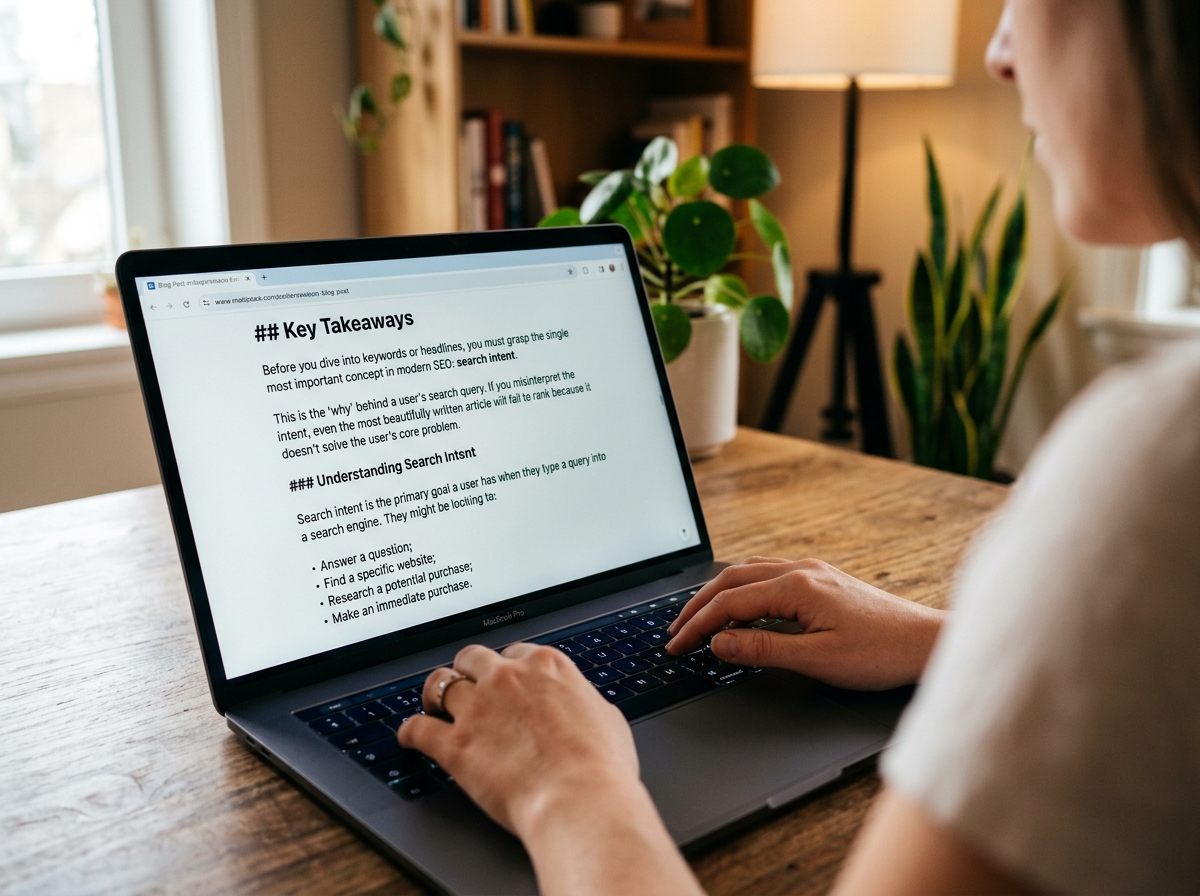
Before you dive into keywords or headlines, you must grasp the single most important concept in modern SEO: search intent. This is the 'why' behind a user's search query. If you misinterpret the intent, even the most beautifully written article will fail to rank because it doesn't solve the user's core problem.
What Exactly is Search Intent?
Search intent is the primary goal a user has when they type a query into a search engine. Are they looking for an answer, trying to find a specific website, researching a purchase, or ready to buy something now? Google's entire business model is built on providing the most relevant result for a user's intent as quickly as possible.
The Four Pillars of Search Intent
Most search queries fall into one of four categories:
- Informational: The user is looking for information. Examples include "what is photosynthesis," "how to tie a tie," or "best dog breeds for apartments." These queries are best answered with comprehensive guides, how-to articles, and detailed explanations.
- Navigational: The user wants to find a specific website or page. Examples: "YouTube," "BestSEOArticles login," or "Twitter." You generally don't target these unless they are for your own brand.
- Commercial Investigation: The user is researching products or services before making a purchase. Examples: "BestSEOArticles vs Jasper," "best 4k tv reviews," or "lightweight running shoes." These are well-suited for comparison articles, reviews, and detailed product guides.
- Transactional: The user is ready to make a purchase or take a specific action. Examples: "buy iPhone 17 pro," "Grammarly subscription discount," or "sign up for Netflix." These queries are typically targeted by product or landing pages.
Why Matching Intent is Non-Negotiable for Ranking Success
Imagine a user searches for "best running shoe reviews" (commercial intent) and your article is a history of the Nike brand (informational intent). Even if your article is well-written, the user will quickly leave because it doesn't satisfy their need. This high bounce rate signals to Google that your page is not a good result for that query, and your rankings will suffer. Matching intent is the first and most critical step in creating SEO-friendly articles.
Laying the Foundation: Advanced Keyword Strategy for Modern SEO
With a clear understanding of intent, you can begin your keyword research. This process has evolved significantly. Instead of just finding one high-volume keyword, the goal is to build a universe of related terms that establish your website as an authority on the entire topic.
Moving Beyond Single Keywords: Embracing Topical Authority
Topical authority is the perceived expertise your website has on a specific subject. You build it by creating a comprehensive cluster of content that covers a topic from every angle. Instead of writing one article on "seo friendly articles," you create a network of content covering related topics like "how to do keyword research," "on-page SEO checklist," and "what is semantic SEO." This signals to Google that you are a definitive source of information.
Uncovering High-Impact Keywords: Primary, Long-Tail, and Question-Based Queries
- Primary Keywords: These are the main, often high-volume, terms that define your article's core topic (e. g., "seo friendly articles").
- Long-Tail Keywords: These are longer, more specific phrases that have lower search volume but much higher conversion potential because the intent is clearer (e. g., "how to write seo friendly articles for a blog").
- Question-Based Queries: These are questions users ask search engines (e. g., "What are the key elements of an SEO article?"). Answering these directly can help you appear in People Also Ask boxes and featured snippets.
Analyzing Keyword Difficulty and Search Volume with Precision
Tools like Ahrefs or SEMrush provide data on how many people search for a keyword (search volume) and how hard it is to rank for (keyword difficulty). For a growing startup or small business, targeting keywords with a healthy search volume and a lower difficulty score is a winning strategy to gain initial traction.
Crafting Content That Captivates Both Readers and Search Engines
Once you have your keywords and a clear understanding of intent, it's time to craft the elements that users and search engines see first: your headlines, meta tags, and overall structure.
The Art of the Irresistible Headline: Hooking Your Audience from the SERP
Your headline (or H1 tag) is your first and only chance to make an impression on the search engine results page (SERP). A great headline is clear, includes the primary keyword, and creates curiosity or communicates a strong benefit.
Pro Tip: Use emotional or power words to make your headline more compelling. Modifiers like "Definitive Guide," "Step-by-Step," "Proven," or including the current year (2026) can significantly increase click-through rates.
Optimizing Title Tags and Meta Descriptions for Maximum Click-Through
While the H1 is on your page, the Title Tag is the blue link that appears in Google's search results. They are often the same, but the Title Tag has specific rules:
- Title Tag: Keep it under 60 characters to avoid it being cut off. Place your primary keyword near the beginning.
- Meta Description: This is the 160-character snippet of text below the title tag. It doesn't directly impact rankings, but a compelling description acts as ad copy, enticing users to click. Include your keyword and a call to action.
Structuring for Clarity: H1s, H2s, H3s, and Scannability
No one wants to read a giant wall of text. A logical structure using heading tags (H1, H2, H3, etc.) creates a scannable outline for your readers and helps search engines understand the relationships between different sections of your content. Use one H1 per page, and then use H2s for main topics and H3s for sub-points within those topics.
The Anatomy of a High-Ranking Article: Essential On-Page Elements
The body of your article is where you deliver on the promise of your headline. Every element must be optimized for both user experience and search engine visibility to create truly SEO-friendly articles.
Engaging Introductions and Compelling Conclusions
Your introduction should hook the reader immediately, confirm that they are in the right place, and state what they will learn. Your conclusion should summarize the key takeaways and provide a clear next step or call to action, leaving the reader with a sense of completion.
Integrating Keywords Naturally: The Power of Semantic SEO (LSI Keywords)
Forget about keyword stuffing. Modern search engines understand context. Semantic SEO involves using terms and phrases that are conceptually related to your primary keyword. For an article on "seo friendly articles," this would include terms like "organic traffic," "content optimization," "user experience," and "topical authority." Including these related concepts demonstrates a deep understanding of the topic.
Enhancing Readability: Short Paragraphs, Bullet Points, and Visual Breaks
Readability is a crucial component of user experience. Improve it by:
- Keeping paragraphs to 2-4 sentences.
- Using bullet points and numbered lists to break up text.
- Using bolding and italics to emphasize key points.
- Incorporating images, charts, and videos to provide visual breaks.
The Strategic Use of Internal and External Links
- Internal Links: These are links to other relevant pages on your own website. They help users discover more of your content and distribute "link equity" or authority throughout your site, which helps build topical authority.
- External Links: These are links to other reputable websites. Linking to authoritative sources to back up your claims shows that your content is well-researched and trustworthy, which is a positive signal for E-E-A-T.
Optimizing Images for Performance and Discoverability
Images make your content more engaging, but they must be optimized. Follow these steps:
- Use Descriptive File Names: Instead of `IMG_1776. jpg`, use `seo-friendly-article-structure. jpg`.
- Write Informative Alt Text: Alt text describes the image for visually impaired users and search engines. It's a great place to include your keyword naturally (e. g., "A diagram showing the proper heading structure for SEO-friendly articles").
- Compress Images: Large image files slow down your page, which hurts user experience and rankings. Use a tool to compress images before uploading.
Building Trust and Authority: E-E-A-T in Action

Google's quality rater guidelines place immense importance on E-E-A-T: Experience, Expertise, Authoritativeness, and Trustworthiness. To rank for competitive topics, your content must excel in these areas.
Demonstrating Expertise and Experience in Your Content
Show, don't just tell. Instead of saying you're an expert, demonstrate it. Include unique insights, data, case studies, or first-hand accounts. The 'Experience' component is a newer addition, emphasizing the value of content created by someone with real-world, hands-on experience with the topic.
The Role of Authoritativeness and Trustworthiness in Ranking
Authoritativeness is about your reputation in your industry. This is built over time through backlinks from other respected sites and mentions of your brand. Trustworthiness is about the accuracy of your content and the security of your site. Include author bios, cite your sources, and ensure your claims are verifiable.
Fact-Checking and Verifiable Claims: A Non-Negotiable Standard
Every statistic, claim, or piece of data in your article must be accurate and, ideally, linked to its original source. Inaccurate or misleading information is a massive red flag for Google and will quickly erode any trust you've built with your audience.
Unlocking Efficiency: How AI Revolutionizes SEO-Friendly Article Creation
Creating content that meets all these criteria is incredibly time-consuming. This is where AI-powered SEO tools have transformed the landscape, moving content creation from a manual chore to a strategic, data-driven process.
Real-Time Competitor Analysis with AI: Outsmarting the Competition
The most advanced AI tools don't just write text; they perform sophisticated research. For example, a platform like BestSEOArticles analyzes the top-ranking Google results for your target keyword *in real-time*. It deconstructs what's already working—the topics covered, the questions answered, the structure used—to provide a data-backed blueprint for an article engineered to outrank them.
AI-Powered Fact-Checking: Ensuring Accuracy and E-E-A-T at Scale
Manually verifying every claim in a 3,000-word article is a monumental task. This is a critical area where AI provides a significant advantage. AI fact-checking capabilities can cross-reference claims against verified sources, ensuring the content you produce is accurate and upholds the high standards of E-E-A-T, which is essential for building trust with both Google and your readers.
Generating Optimized Outlines and Comprehensive Topical Coverage in Minutes
One of the biggest hurdles in writing SEO-friendly articles is knowing what to include. AI can generate a comprehensive, optimized outline based on its competitor analysis. This ensures you cover all the essential subtopics and entities needed to achieve topical authority, eliminating the guesswork from the content planning process.
From Keyword to Publish-Ready: The Speed and Scale of AI SEO
The efficiency gains are undeniable. What once took a team of writers and SEOs days to research, outline, write, and optimize can now be accomplished in minutes. This speed allows solo founders and small agencies to compete on a level playing field with larger corporations, scaling their content production without sacrificing quality.
Identifying and Closing Content Gaps for Unrivaled Visibility
A content gap is a topic your target audience is searching for, but you (or your competitors) haven't covered adequately. Finding and filling these gaps is a powerful strategy for capturing new organic traffic.
What is a Content Gap and Why Does it Matter?
A content gap exists when user search intent is not being fully met by the current search results. By creating content that specifically addresses these unmet needs, you can often rank quickly because you're providing a unique and valuable resource.
Performing a Data-Driven Content Gap Analysis
You can identify content gaps by analyzing competitor websites to see what keywords they rank for that you don't. You can also look at "People Also Ask" sections in Google search results and online forums like Reddit or Quora to see what questions people are asking about your industry.
Expert Insight: AI-driven tools accelerate this process exponentially. They can systematically analyze competitor content at scale, identifying not just missing keywords but entire subtopics and user questions that top-ranking articles have overlooked, presenting you with clear opportunities to create superior content.
Beyond Publication: Maintaining and Maximizing Your SEO-Friendly Articles
Your work isn't done once you hit "publish." The digital landscape is always changing, and your content needs to evolve with it.
The Importance of Regular Content Updates and Refreshes
Information becomes outdated. Regularly review your top-performing articles to update statistics, fix broken links, and add new, relevant information. A "content refresh" can significantly boost the rankings of an older article, signaling to Google that it is still current and valuable.
Monitoring Performance and Adapting Your Strategy
Use tools like Google Analytics and Google Search Console to track your article's performance. Monitor metrics like organic traffic, keyword rankings, and click-through rate. This data will tell you what's working and where you need to adjust your content strategy.
Empower Your Content Strategy with BestSEOArticles
Creating high-ranking, SEO-friendly articles consistently is the key to sustainable organic growth. The principles outlined in this guide—from understanding intent to demonstrating E-E-A-T—are the building blocks of success. However, executing this strategy at scale requires a new level of efficiency and data intelligence.
This is where an AI-powered platform becomes an indispensable partner. By leveraging real-time competitor analysis and AI-driven content generation, you can ensure every article you publish is strategically designed to rank. You can transform a keyword into a fully researched, fact-checked, and optimized article in minutes, not days, giving you the power to build topical authority and capture Google traffic for your business.
Frequently Asked Questions (FAQ)
How long should an SEO-friendly article be?
The ideal length depends on the topic and search intent. While many high-ranking comprehensive guides tend to be substantial, the primary focus should always be on providing a complete answer rather than adhering to an arbitrary word count.
How many keywords should I use in an article?
Focus on one primary keyword and a handful of secondary, long-tail keywords. More importantly, incorporate a wide range of semantically related terms and phrases naturally throughout the text to build topical relevance without keyword stuffing.
Can I write SEO-friendly articles myself without any tools?
Yes, it's possible to apply the fundamental principles manually. However, using SEO tools for keyword research, competitor analysis, and on-page optimization provides data-driven insights that are nearly impossible to replicate by hand, significantly increasing your chances of success and saving immense amounts of time.
Is content generated by AI considered SEO-friendly?
Google's stance is that it rewards high-quality content, regardless of how it's produced. AI-generated content that is generic or inaccurate will perform poorly. However, content produced by advanced AI systems that perform real-time research, fact-checking, and optimization to create helpful, reliable, people-first content is highly effective for SEO.
How often should I publish new SEO articles?
Consistency is more important than frequency. Whether it's once a week or once a month, choose a publishing schedule you can maintain. Quality always trumps quantity; one excellent, comprehensive article is better than five mediocre ones.
Conclusion: Your Path to Sustainable Organic Growth
Writing SEO-friendly articles in 2026 is a sophisticated blend of art and science. It requires a deep empathy for the user's needs, a strategic approach to data, and an unwavering commitment to quality and authority. By mastering the fundamentals of search intent, building topical authority, structuring your content for clarity, and upholding the principles of E-E-A-T, you lay the groundwork for success.
In today's competitive environment, leveraging AI is no longer just an option—it's the key to executing this strategy with the speed and precision necessary to win. By embracing AI-powered research and content creation, you can consistently produce articles that not only rank but also build lasting trust with your audience, turning search visibility into sustainable business growth.
Generate SEO articles with AI
Publish SEO content built on real competitor analysis, ready for your CMS.
Buy →