Navigating Google Algorithm Updates: A How-To Guide for Measuring Marketing Performance
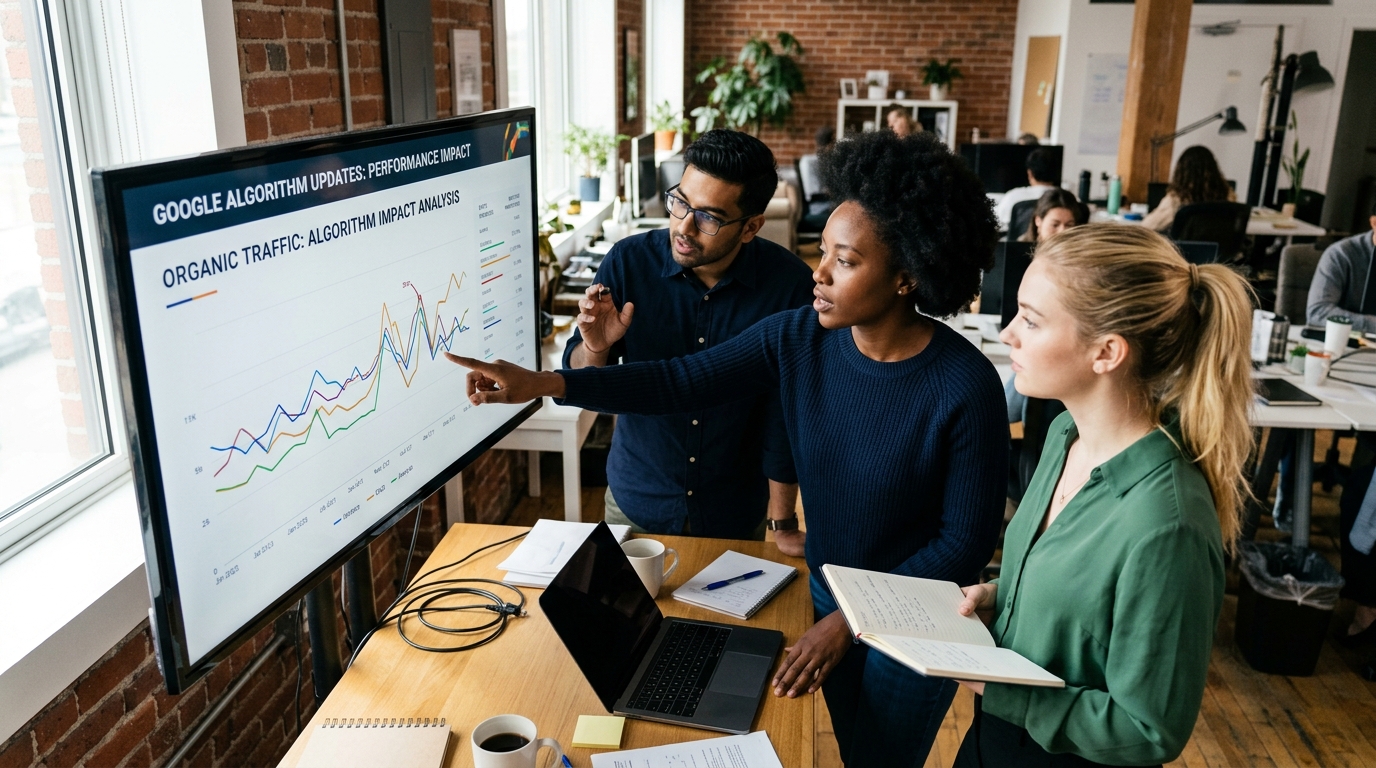
To measure marketing performance after a Google algorithm update, you must first establish a baseline of your key metrics in Google Analytics 4 and Search Console. Then, correlate any significant performance shifts—like drops in organic traffic or keyword rankings—with the known dates of the update. By segmenting your data and analyzing affected pages, you can differentiate the algorithm's impact from other factors and formulate a targeted content and technical SEO recovery plan.
Key Takeaways
- Establish a Baseline: You cannot measure change without knowing your starting point. Regularly document your average organic traffic, top keyword positions, and conversion rates.
- Correlate, Don't Assume: The core of analysis is overlaying known algorithm update dates with your performance data. A drop that coincides perfectly with a confirmed update is a strong signal.
- Segment for Clarity: Broad traffic drops are vague. Segment your data by page, keyword group, device, or country to pinpoint the exact areas of your site that the algorithm re-evaluated.
- Rule Out Other Causes: Not every dip is an algorithm update. Investigate seasonality, recent site changes, new competitor strategies, and technical SEO issues before drawing conclusions.
- Focus on E-E-A-T: Modern Google updates consistently reward content demonstrating high levels of Experience, Expertise, Authoritativeness, and Trustworthiness. This should be a central focus of your adaptation strategy.
- Leverage AI for Speed and Insight: AI tools can automate the tedious process of competitor analysis and content auditing, helping you understand new ranking patterns and adapt your strategy faster.
- Resilience Over Reaction: The best strategy is proactive. Build a technically sound website with a strong user experience and a library of comprehensive, helpful content to minimize the impact of future updates.
The Constant Evolution of Google's Algorithm: Why Measurement Matters More Than Ever
Google's search algorithm is not a static set of rules; it's a dynamic, continuously learning system. It undergoes thousands of minor tweaks annually and several major, announced "core updates." These changes are designed to improve the quality and relevance of search results, but for businesses, they can feel like unpredictable seismic shifts that reorder the digital landscape overnight.
Understanding the Dynamic Nature of Search
Think of the algorithm as Google's ongoing effort to better understand user intent and content quality. Updates might target spam, reward mobile-friendly pages, or, as is common today, better evaluate the helpfulness and trustworthiness of content. Ignoring these shifts is not an option, as your marketing performance is directly tied to your visibility within this evolving ecosystem.
The Business Impact of Algorithm Shifts
A sudden drop in organic traffic isn't just a line on a graph; it's a direct hit to your lead generation, sales, and brand visibility. Conversely, a positive impact can dramatically accelerate growth. This is why a robust process to measure marketing performance during Google algorithm updates is not just an SEO task—it's a critical business function. It transforms you from a passive victim of change into an active, data-informed strategist.
Core Metrics for Tracking SEO Performance

Before you can diagnose an algorithm's impact, you must have a firm grasp on your key performance indicators (KPIs). These metrics, primarily found in Google Analytics 4 (GA4) and Google Search Console (GSC), are the vital signs of your website's health.
Organic Traffic: Quantity and Quality
This is the most obvious metric. A sharp, sustained drop in organic sessions is often the first alarm bell. But don't just look at the total number. Analyze traffic to key sections of your site (e. g., blog vs. product pages) to see where the impact is most concentrated.
Keyword Rankings: Visibility and Volatility
While chasing individual rankings can be misleading, tracking the overall visibility of your target keyword clusters is essential. Did a whole group of related keywords drop in position? Did you lose rankings for high-intent commercial terms? This tells you what kind of content Google is re-evaluating.
Impressions and Click-Through Rate (CTR)
Found in GSC, impressions show how often your pages appear in search results. A drop in impressions means you're appearing for fewer queries. A drop in CTR, while impressions remain stable, might suggest your title tags and meta descriptions are no longer compelling, or that competitors have improved theirs.
Conversion Rates: Connecting SEO to Revenue
Ultimately, traffic is a means to an end. Track your organic conversion rate (e. g., form fills, purchases, sign-ups). If an update sends you less qualified traffic, you might see conversions drop even if your traffic numbers remain somewhat stable. This is a crucial metric for measuring the true business impact.
Technical Health Indicators: Core Web Vitals and Beyond
Don't overlook the technical side. Metrics like Core Web Vitals (LCP, INP, CLS), mobile-friendliness, and crawl errors reported in GSC are direct ranking factors. A sudden negative change here can coincide with performance drops, indicating a technical, rather than content-focused, issue.
How to Measure the Impact of Google Algorithm Updates on Your Marketing
When you suspect an algorithm update has affected your site, a structured, methodical approach is essential to get clear answers. Follow this step-by-step process to move from panic to a data-driven action plan.
- Establish Your Baseline Performance. Before an update hits, you should know what "normal" looks like. In GA4, look at your organic traffic over the last 30-90 days. Note your average daily sessions, top landing pages, and conversion rate. This is your benchmark.
- Stay Informed About Algorithm Announcements. You can't correlate a drop with an update if you don't know an update happened. Follow the official Google Search Central Blog and reputable SEO news outlets. Mark the confirmed start and end dates of rollouts on a calendar.
- Monitor Your Analytics Daily (and Weekly). During a known rollout period, check your analytics more frequently. In GA4, go to Reports > Acquisition > Traffic acquisition and filter for the "Organic Search" channel. Look for sharp deviations from your baseline.
- Correlate Performance Shifts with Update Dates. This is the critical step. In your analytics tool, set the date range to include the period before, during, and after the update. Does a significant drop or spike in traffic align with the day the update was announced? A clear correlation is your strongest piece of evidence.
- Segment Your Data for Deeper Insights. A site-wide drop is just the starting point. Dig deeper:
- By Landing Page: Which specific pages lost the most traffic? Look for patterns. Are they all blog posts? Product pages?
- By Device: Did mobile traffic drop more than desktop? This could point to a mobile usability issue.
- By Keyword: In GSC, compare performance for key query groups before and after the update. Did you lose visibility for "how-to" informational queries or "buy now" commercial queries?
- Conduct a Content Performance Audit. Gather the list of your most-affected pages from the previous step. Manually review them. How do they compare to the pages that are now outranking you? Is the competing content more comprehensive, better structured, or does it show more first-hand experience?
- Analyze Competitor Performance (with AI Assistance). Your site doesn't exist in a vacuum. Was the update site-specific, or did it shake up your entire industry? Manually tracking this is incredibly time-consuming. AI SEO platforms like BestSEOArticles can assist with competitor analysis, helping to identify shifts in ranking for target keywords and understand emerging patterns of success.
- Perform a Technical SEO Review. Go to GSC and check for any new issues under the Indexing > Pages and Experience > Core Web Vitals reports. Sometimes an update can be more sensitive to technical flaws that were previously overlooked.
- Assess E-E-A-T Signals. Critically evaluate the Experience, Expertise, Authoritativeness, and Trustworthiness of your affected content. Does the author have demonstrable experience on the topic? Are claims backed by credible sources? Is it clear who is behind the website? These qualitative factors are increasingly important algorithmic signals.
- Formulate an Action Plan. Based on your complete analysis, create a prioritized list of actions. This could range from rewriting thin content and improving author bios to fixing technical issues or building a more robust internal linking structure.
Differentiating Algorithm Impacts from Other Factors
It's easy to blame Google for every traffic fluctuation, but other forces are often at play. Before you embark on a massive content overhaul, make sure you've ruled out these common culprits.
Pro Tip: Never analyze a performance drop in isolation. Always cross-reference your SEO data with your other marketing channels, PR activities, and any changes made to the website's code or content. The cause is often found at the intersection of these events.
Seasonality and Industry Trends
Does your business have a natural ebb and flow? A retailer of ski equipment will naturally see a traffic dip in June. Use Google Trends to check for declining search interest in your core topics. Compare your performance to the same period last year (year-over-year analysis) to account for seasonal patterns.
Competitor Activity and New Entrants
A savvy competitor might have launched a major content marketing campaign or a new product that's capturing your audience's attention. A new, well-funded player entering your market can also disrupt existing rankings. This is where ongoing competitor monitoring becomes invaluable.
Technical Glitches and Website Changes
Did you recently launch a site redesign, migrate to a new server, or change your URL structure? Often, the cause of a traffic drop is self-inflicted. A misconfigured `robots. txt` file, broken redirects, or new crawl errors can devastate your SEO performance and mimic the effects of an algorithm update.
Link Profile Changes and Penalties
While less common, a manual action (penalty) from Google for violating their spam policies can cause a catastrophic drop in traffic. You'll find a notification for this in Google Search Console. Additionally, losing a significant number of high-quality backlinks can also negatively affect your authority and rankings.
Adapting Your SEO Strategy for Algorithm Resilience

Reacting to updates is necessary, but building a resilient website that can withstand algorithmic turbulence is the smarter long-term play. This involves shifting your focus from chasing algorithm signals to creating genuine value for your users.
Prioritizing User Experience (UX)
A website that is fast, easy to navigate, and mobile-friendly is fundamental. Google wants to send users to pages they'll enjoy using. Focus on clear navigation, fast load times (Core Web Vitals), and a design that helps users accomplish their goals without friction.
Building Topical Authority with Comprehensive Content
Instead of writing isolated articles, build topic clusters. Create a comprehensive pillar page covering a broad topic and surround it with detailed articles that cover specific sub-topics, all linking back to the pillar. This signals to Google that you are an authority on the subject.
The Importance of E-E-A-T in a Post-Update World
Demonstrating Experience, Expertise, Authoritativeness, and Trustworthiness is non-negotiable. This means:
- Featuring clear author bios with credentials.
- Citing credible, primary sources for claims.
- Showcasing real-world experience through case studies and unique examples.
- Making contact information and company details easy to find.
Continuous Technical SEO Optimization
Technical SEO is not a one-time setup. Regularly audit your site for crawl errors, broken links, and opportunities to improve your site structure and schema markup. A technically healthy site provides a solid foundation that allows your great content to shine.
Leveraging AI for Smarter Algorithm Adaptation
The speed and complexity of Google updates demand more efficient workflows. AI is no longer a futuristic concept; it's a practical tool for solo founders and small teams to analyze, adapt, and execute SEO strategy at scale.
Real-Time Competitor Analysis for Algorithm Shifts
After an update, one of the most valuable questions is: "What are the newly-ranking pages doing right?" Manually deconstructing dozens of top articles is a multi-day task. AI tools can analyze the top 10-20 search results for a keyword in seconds, identifying common headings, entities, word counts, and content structures that are now being rewarded.
AI-Powered Content Audits and Optimization
AI can rapidly scan your affected content and compare it against the new top-ranking pages. It can identify content gaps, suggest missing subtopics, and recommend optimizations to better align your article with what Google's algorithm now considers comprehensive and helpful.
Fact-Checking New SEO Claims with AI
The aftermath of an algorithm update is filled with noise—everyone has a new theory or "best practice." Advanced AI platforms can help validate these claims by cross-referencing them with multiple authoritative sources, ensuring you're acting on credible information, not just speculation.
A New Way to Adapt: Instead of spending days on analysis and weeks on content creation, you can now move from insight to execution in minutes. The right AI platform can handle the heavy lifting of research and writing, freeing you to focus on strategy.
Automated Content Generation for Algorithm-Proofing
The most direct way to adapt is to improve or create content that meets the new standards. This is where AI excels. For instance, BestSEOArticles utilizes real-time competitor analysis and AI fact-checking to efficiently generate publish-ready, comprehensive articles. This allows you to rapidly update underperforming content or build out new topic clusters with content that's inherently designed to be algorithm-resilient from the start.
Frequently Asked Questions (FAQ)
What is the first thing to do after a suspected Google update?
Don't panic. The first step is to verify if a significant, sustained performance change has occurred in GA4 and GSC. Then, check official Google sources and the SEO community to confirm if an update was actually announced or is being widely observed.
How long does it take to recover from an algorithm update?
Recovery time varies widely. It depends on the nature of the update, the extent of the issues on your site, and how quickly you can implement effective changes. It can take anywhere from a few weeks to several months. Recovery is often gradual and may not happen until the next major core update.
Can a single algorithm update affect only specific pages?
Absolutely. Many updates, especially those related to content quality like the Helpful Content System, are page-specific. The algorithm evaluates content on a granular level, so it's common to see some pages drop while others remain stable or even rise.
How can I stay informed about new Google updates?
Follow the official Google Search Central Blog and their account on X (formerly Twitter). Additionally, subscribe to reputable industry publications like Search Engine Journal or Search Engine Land, which provide analysis and community insights during rollouts.
Is it possible to "future-proof" my SEO?
While no site is 100% immune to algorithm changes, you can build for resilience. Focus relentlessly on serving your target user with high-quality, trustworthy content on a technically sound, fast, and easy-to-use website. This user-centric approach aligns with Google's long-term goals, making your site less susceptible to negative impacts.
Conclusion: Master the Algorithm, Master Your Marketing
Measuring the impact of Google algorithm updates is no longer an arcane art but a necessary business discipline. By moving beyond simple traffic observation to a structured process of correlation, segmentation, and analysis, you can turn volatility into opportunity. The key is to understand that Google is almost always trying to better reward content that is genuinely helpful, experienced, and trustworthy.
Your goal is not to "beat" the algorithm but to align your marketing strategy with its core principles. By combining a deep understanding of your audience with the speed and analytical power of modern AI tools, you can build a resilient SEO foundation that not only weathers the updates but thrives because of them.
Ready to streamline your SEO content creation and ensure your strategy is always aligned with Google's latest algorithms? Explore how an AI SEO platform can empower you to generate high-ranking, fact-checked content with unparalleled efficiency and accuracy.
Generate SEO articles with AI
Publish SEO content built on real competitor analysis, ready for your CMS.
Buy →