How to Master SEO Article Creation: A Step-by-Step Guide for Ranking High in Google

Mastering SEO article creation involves a systematic process of identifying high-intent keywords, structuring content for both users and search engines, optimizing on-page elements, and ensuring factual accuracy. The goal is to produce comprehensive, authoritative content that directly answers a user's query, which in turn earns high rankings on Google. This process can be significantly accelerated by leveraging AI tools that automate research, writing, and optimization based on real-time data.
Key Takeaways
- Intent is King: Successful SEO article creation starts with deeply understanding the user's search intent—what they want to accomplish—and aligning your content to meet that need precisely.
- Structure Dictates Success: A logical article structure using clear headings (H1, H2, H3), short paragraphs, and lists improves readability and helps search engines understand your content's hierarchy and relevance.
- On-Page SEO is Non-Negotiable: Beyond keywords, optimizing elements like meta descriptions, URL slugs, image alt text, and internal links is crucial for signaling relevance and authority to Google.
- Topical Authority Beats Keyword Density: Modern SEO focuses on comprehensive topical coverage, not just repeating keywords. Incorporating related concepts and entities demonstrates true expertise.
- Accuracy Builds Trust (E-E-A-T): In the age of AI, fact-checking and citing credible sources are critical for establishing Expertise, Experience, Authority, and Trustworthiness, which are key ranking factors.
- AI is a Force Multiplier: Intelligent automation tools can transform the content creation workflow, reducing the time from keyword to publish-ready article from days to mere minutes without sacrificing quality.
- Performance Analysis Drives Growth: The job isn't done at publishing. Tracking key metrics and periodically refreshing your content is essential for maintaining and improving rankings over time.
Why SEO Article Creation is Your Key to Unlocking Organic Growth
The Power of Targeted Content in Today's Search Landscape
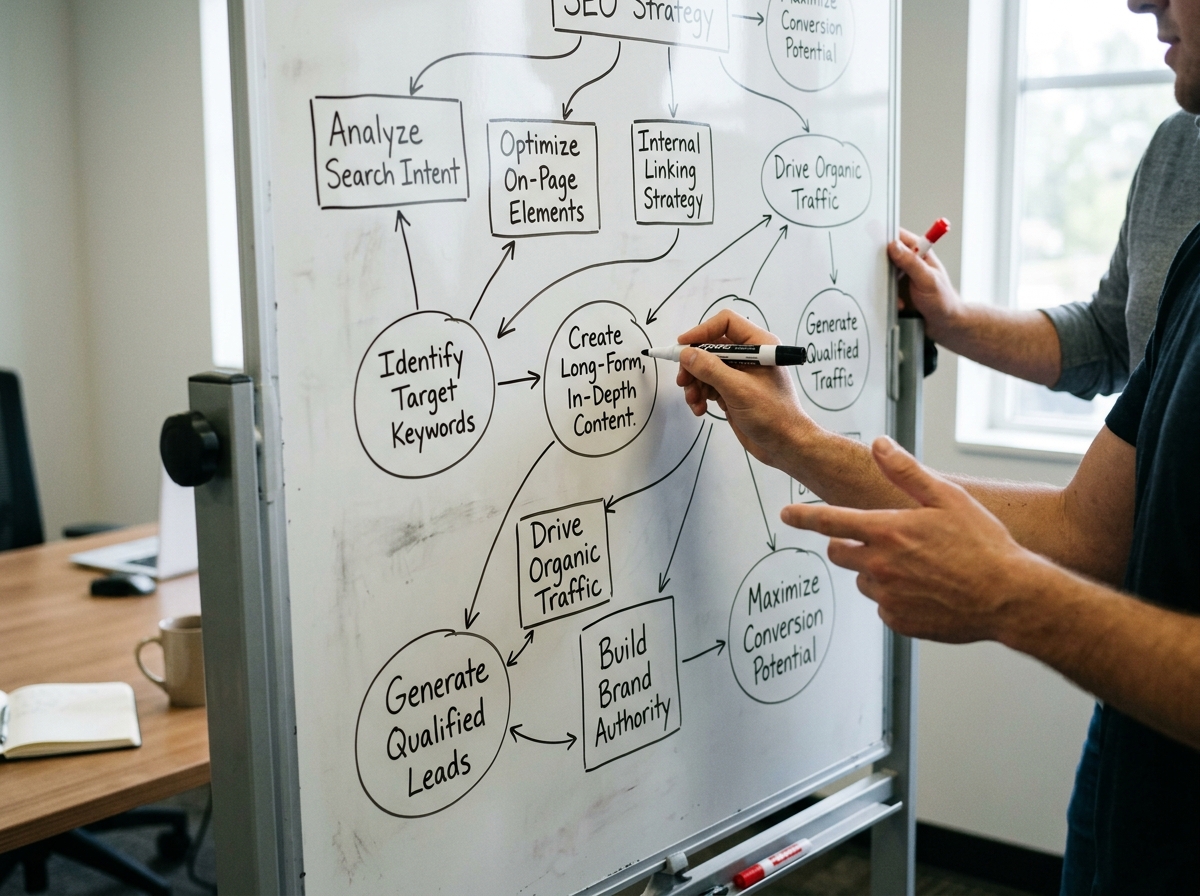
In the digital marketplace, your website is your storefront, and high-ranking articles are the signposts that guide customers to your door. Effective SEO article creation isn't just about writing; it's a strategic discipline that directly fuels business growth. When you create content that ranks for valuable keywords, you attract a consistent stream of qualified leads, build brand authority, and establish a direct line of communication with your target audience. Each well-crafted article is an asset that works for you 24/7, generating organic traffic and conversions long after you hit publish.
Overcoming the Challenges of Traditional Content Generation
For many solo founders and small agencies, the traditional content process is a significant bottleneck. It's a time-intensive cycle of keyword research, competitor analysis, outlining, drafting, editing, and optimizing. This process is often fraught with challenges: the data becomes stale quickly, it's difficult to scale, and there's no guarantee the final product will rank. The result is often burnout and inconsistent output, leaving valuable organic traffic on the table. This is where a new approach, powered by intelligent automation, changes the game entirely.
Step 1: Unearthing High-Impact Keywords and Understanding Search Intent
Beyond Volume: Identifying Strategic Keywords
The foundation of any successful SEO article is choosing the right keywords. While high search volume might seem appealing, the most valuable keywords are those with a clear connection to your business goals and a manageable level of competition. Focus on identifying a primary keyword (the main topic) and a cluster of secondary, long-tail keywords (more specific, multi-word phrases). These long-tail keywords often have lower competition and higher conversion rates because they capture users with a more specific need.
Deciphering User Intent: Informational vs. Commercial
Understanding why someone is searching is more important than knowing what they are searching. Search intent generally falls into four categories:
- Informational: The user is looking for information (e. g., "how does photosynthesis work").
- Navigational: The user wants to find a specific website (e. g., "BestSEOArticles login").
- Transactional: The user intends to make a purchase (e. g., "buy SEO content software").
- Commercial Investigation: The user is comparing products before a purchase (e. g., "BestSEOArticles vs competitor").
Your article must align perfectly with the dominant intent for your target keyword. An informational "how-to" guide will fail if the top results for the keyword are all e-commerce product pages.
BestSEOArticles Integration: How real-time competitor analysis informs keyword selection
Traditional keyword tools often rely on cached data that can be weeks or months old. In a dynamic search landscape, this is a critical flaw. Tools like BestSEOArticles analyze Google's top-10 results for your target keyword in real-time. This provides a current, accurate picture of what Google is rewarding right now, helping you validate keyword intent and uncover the exact subtopics and angles that are proven to rank.
Step 2: Crafting a Winning Outline: The Blueprint for Ranking Content
Structuring for Clarity and Comprehensive Coverage
An outline is the architectural blueprint for your article. It ensures a logical flow, prevents you from missing crucial subtopics, and makes the writing process significantly smoother. A strong outline organizes your content hierarchically using headings and subheadings (H1, H2, H3, etc.). This not only guides the reader through the material but also helps search engine crawlers understand the structure and key themes of your content.
A well-structured article that covers a topic comprehensively is more likely to achieve topical authority. Google doesn't just rank content for a single keyword; it ranks content that demonstrates a deep understanding of the entire subject matter.
Leveraging Competitor Insights for Optimal Outlines
Manually analyzing the top-ranking articles to build an outline is a tedious but necessary task. You need to identify common headings, recurring questions, and content gaps that you can fill. Look for the patterns in what the top results cover—these are strong clues about what Google considers relevant and important for that query.
BestSEOArticles Integration: Generating optimized outlines in minutes
Instead of spending hours manually piecing together an outline, AI-powered platforms can automate this process. By analyzing the real-time top results, BestSEOArticles identifies the essential headings, entities, and questions that need to be included. It then generates a comprehensive, optimized outline designed to outperform the current competition, giving you a strategic advantage before you even write a single word.
Step 3: Writing for Both Readers and Search Engines

Engaging Introductions and Compelling Headlines
Your headline (H1 tag) is your first and most important promise to the reader. It must be compelling enough to earn a click from the search results page. Your introduction must then deliver on that promise within the first few sentences. Hook the reader by stating the problem, empathizing with their challenge, and clearly explaining how your article provides the solution. Remember to include your primary keyword naturally within the first 100 words.
Developing Rich, Informative Body Content
The body of your article is where you deliver value. Follow your outline and flesh out each section with detailed, accurate, and engaging information. Use these techniques to improve readability and user experience:
- Short Paragraphs: Keep paragraphs to 2-4 sentences to avoid intimidating walls of text.
- Active Voice: Use active voice for more direct and energetic prose (e. g., "You should optimize your content" instead of "Your content should be optimized").
- Clear Language: Avoid jargon and explain complex topics in simple terms.
- Visuals: Break up text with relevant images, charts, and videos.
Integrating Keywords Naturally: The Art of Semantic SEO
The era of keyword stuffing is long gone. Modern SEO is about semantic relevance. This means naturally incorporating your primary, secondary, and LSI (Latent Semantic Indexing) keywords throughout the text. Think of it as having a natural conversation about a topic. You wouldn't repeat the exact same phrase over and over; you'd use synonyms and related concepts. This is how search engines now measure topical relevance.
Step 4: Optimizing On-Page Elements for Maximum Visibility
Meta Descriptions and URL Structure: Your Article's First Impression
Your meta title and meta description serve as your article's introduction on the search engine results page (SERP). It's generally recommended to keep titles concise, often under 60 characters, and descriptions under 160 characters, while including your primary keyword and a compelling summary to encourage clicks. However, Google may display different lengths or even rewrite them based on the user's query. Your URL slug should also be short, descriptive, and include the primary keyword (e. g., `yourdomain. com/seo-article-creation`).
Image Optimization and Internal/External Linking Strategies
Every image you use should have descriptive alt text that explains what the image is about, ideally including a relevant keyword. This helps with accessibility and image search rankings. Furthermore, your linking strategy is critical:
- Internal Links: Link to other relevant pages on your own website to help users and search engines discover more of your content and to distribute page authority.
- External Links: Link out to reputable, authoritative sources to back up your claims. This signals to Google that your content is well-researched and trustworthy.
The Role of Structured Data and Entity Mapping for Authority
Structured data (or schema markup) is code you can add to your site to help search engines better understand your content. For articles, this can include marking up things like FAQs, how-to steps, or author information. Entity mapping goes a step further, focusing on including well-defined concepts (people, places, organizations, ideas) that are relevant to your topic. Covering these entities helps Google recognize your content as a comprehensive resource, boosting its topical authority.
Step 5: Ensuring Accuracy and Trustworthiness with AI Fact-Checking
The E-E-A-T Imperative: Expertise, Experience, Authority, Trustworthiness
Google's quality guidelines heavily emphasize E-E-A-T. To rank, your content must be perceived as credible. This is especially true in the era of widespread AI-generated content, where misinformation can spread rapidly. Every claim, statistic, and fact you present must be verifiable and accurate. Citing your sources and linking to authoritative studies is no longer optional; it's a requirement for building the trust that underpins high rankings.
BestSEOArticles Integration: How AI fact-checking builds credibility
Manually fact-checking every statement in a 3,000-word article is a monumental task. This is where AI fact-checking becomes a game-changer. For example, if an AI draft claims that "50% of all website traffic comes from organic search," the AI fact-checking feature in BestSEOArticles cross-references this claim against a database of trusted sources in real-time. It can then verify the statistic and even insert a citation, preventing the publication of unsubstantiated claims and reinforcing your site's E-E-A-T signals.
Step 6: Streamlining Your Workflow with AI-Powered Article Generation
Automating Research and Draft Creation
The most significant drain on resources in content creation is the time spent on research and initial drafting. AI can now condense this multi-day process into minutes. By providing a target keyword, AI platforms can perform the real-time competitor analysis, identify content gaps, generate an optimized outline, and write a full, high-quality draft that incorporates all the SEO best practices discussed so far.
This isn't about replacing human strategy; it's about augmenting it. AI handles the 80% of repetitive, data-driven work, freeing up founders and marketers to focus on the 20% that requires high-level strategy, brand voice, and unique insights.
From Keyword to Publish-Ready Article in Minutes with BestSEOArticles
The ultimate goal is efficiency without sacrificing quality. A platform like BestSEOArticles embodies this principle, aiming to deliver a complete, publish-ready article rapidly after you enter a keyword. This includes:
- A fully researched and written article based on top-ranking content.
- Built-in AI fact-checking with citations.
- AI-generated, relevant images.
- Complete on-page optimization, including meta descriptions and entity mapping.
This level of automation enables teams to scale their content production from one article a week to multiple articles a day, dramatically accelerating organic growth.
Step 7: Publishing and Promoting Your High-Ranking Content
Autopilot Publishing: Reaching Your Audience Instantly
The final step in creation is getting the content live. Modern AI tools are increasingly offering direct integrations with popular content management systems. For instance, the autopilot publishing feature allows you to send your finalized, optimized article directly to platforms like WordPress, Ghost, Webflow, or Shopify with a single click, eliminating the tedious copy-pasting and reformatting process.
Beyond Publishing: Strategies for Content Amplification
Hitting "publish" is the start, not the finish line. To maximize your article's impact, you need to promote it. Share it across your social media channels, send it to your email list, and repurpose it into different formats like videos or infographics. The more initial traction you can generate, the faster Google is likely to take notice and reward your content.
Step 8: Analyzing Performance and Continuously Optimizing
Key Metrics to Track for SEO Article Success
Once your article is live, it's time to measure its performance. Using tools like Google Analytics and Google Search Console, you should track these key metrics:
- Organic Traffic: How many visitors are coming to the article from search engines?
- Keyword Rankings: Where does your article rank for its primary and secondary keywords?
- Click-Through Rate (CTR): What percentage of people who see your article in the SERPs actually click on it?
- Bounce Rate: What percentage of visitors leave after viewing only one page? (A high bounce rate might indicate a mismatch with searcher intent).
- Time on Page: How long are users spending reading your article? (Longer times signal higher engagement).
- Conversions: Is the article driving desired actions, like sign-ups or purchases?
Updating and Refreshing Content for Sustained Rankings
SEO is not a "set it and forget it" activity. Over time, information can become outdated, and new competitors will emerge. Periodically review your top-performing articles. Can you add new information? Update statistics? Improve the examples? Refreshing your content is a powerful strategy to protect and even improve your existing rankings.
Frequently Asked Questions about SEO Article Creation
How long should an SEO article be?
The ideal length depends on the keyword and competitor analysis. A common strategy is to analyze the average word count of top-ranking pages and aim for comprehensive coverage, which for competitive topics, can often result in longer articles.
What is the most important part of SEO article creation?
While all steps are important, understanding and matching search intent is the most critical factor. If your content doesn't align with what the user wants to achieve, it will not rank, no matter how well-optimized it is.
Can AI really write content that ranks on Google?
Yes, when used correctly. AI tools that perform real-time analysis, focus on topical authority, and ensure factual accuracy can produce highly competitive content. The key is using AI to augment human strategy, not to blindly generate low-quality text.
How often should I publish new SEO articles?
Consistency is more important than frequency. Whether it's once a week or five times a week, establish a realistic publishing schedule you can stick to. Consistent publishing signals to Google that your site is an active and reliable source of information.
What is the difference between on-page and off-page SEO?
On-page SEO refers to optimizations you make on your website, such as content, headings, and image alt text. Off-page SEO refers to actions taken outside of your website to impact your rankings, primarily building high-quality backlinks from other sites.
Conclusion: Elevate Your SEO Article Creation with Intelligent Automation
The Future of High-Ranking Content is Here
The principles of creating valuable, user-centric content remain the same, but the tools we use to achieve this are evolving rapidly. The traditional, time-consuming methods of content creation are no longer sustainable for businesses that need to scale. Intelligent automation, grounded in real-time data and a commitment to accuracy, is the new standard for effective SEO article creation.
Ready to Transform Your Content Strategy?
By embracing a workflow that prioritizes strategy and automates execution, you can produce more high-ranking content in less time, unlocking the consistent organic growth your business needs. If you're ready to move beyond the constraints of the old process and see how AI can streamline your entire content pipeline, exploring an advanced solution is your logical next step. Discover how you can implement this modern approach with a tool designed for today's SEO landscape.
Generate SEO articles with AI
Publish SEO content built on real competitor analysis, ready for your CMS.
Buy →