SEO Article Length: Beyond Word Count – The Data-Driven Guide to Ranking Content in 2026

There is no single magic number for the ideal SEO article length. The optimal word count is determined by three critical factors: the user's search intent, the complexity of the topic, and the depth of content provided by top-ranking competitors. Your goal is to create the most comprehensive and satisfying answer for a given query, which often results in longer, more in-depth articles for competitive topics.
Key Takeaways
- No Magic Number Exists: Google does not use word count as a direct ranking factor. Stop chasing an arbitrary number and focus on value.
- Search Intent is King: The user's goal (e. g., a quick answer vs. in-depth research) is the primary determinant of appropriate content length.
- Analyze the SERPs: The top-ranking pages for your target keyword provide the best blueprint for the expected depth and word count range.
- Depth Over Length: Comprehensive coverage and true expertise (depth) are what matter. A high word count is often a byproduct of achieving this depth, not the goal itself.
- Content Type Dictates Length: Pillar pages and ultimate guides are typically much longer than product descriptions, reflecting their comprehensive nature versus the concise, conversion-focused goal of product pages.
- Quality Trumps Quantity: A 1,500-word article that perfectly answers a query will always outperform a 3,000-word article filled with irrelevant information.
- Structure is Crucial for Long Content: Use headings, lists, and visuals to make long-form content scannable and user-friendly, improving engagement signals like dwell time.
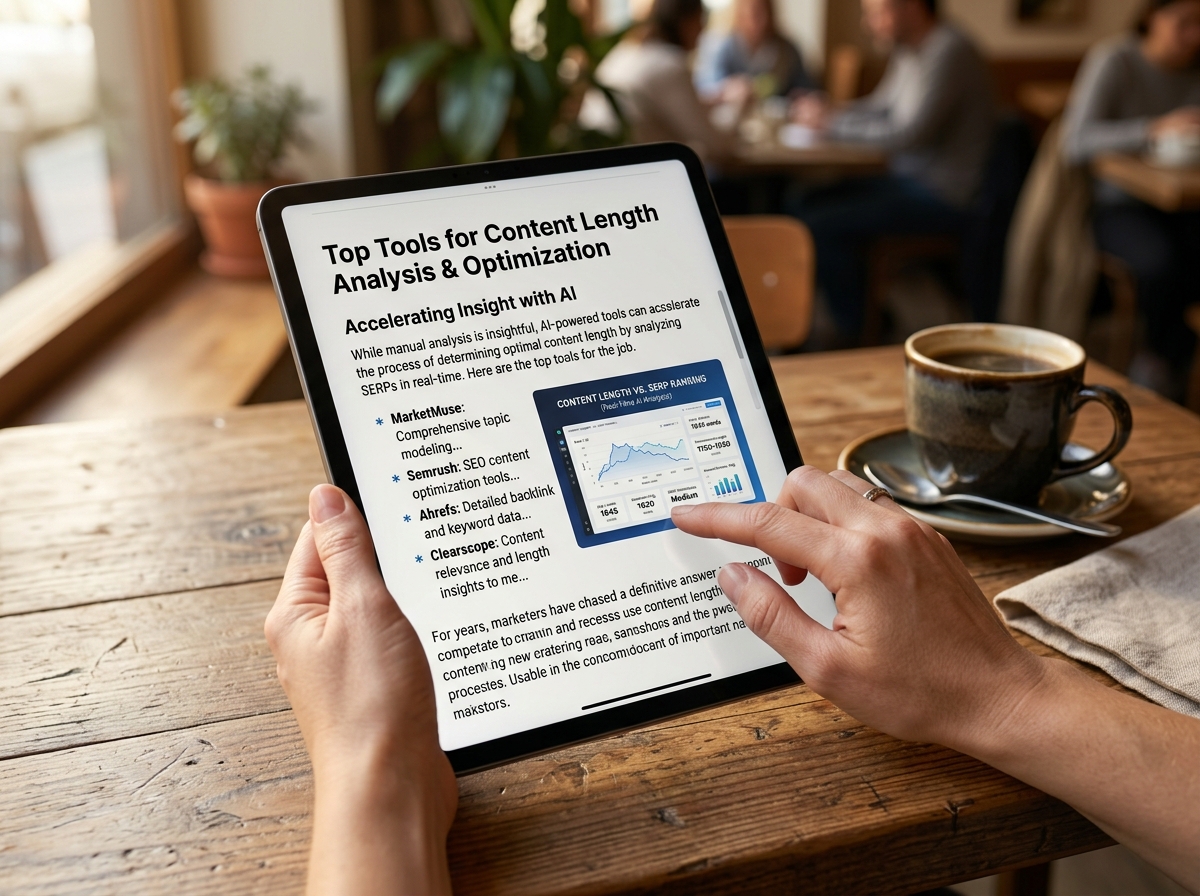
Top Tools for Content Length Analysis & Optimization
While manual analysis is insightful, AI-powered tools can accelerate the process of determining optimal content length by analyzing SERPs in real-time. Here are the top tools for the job.
- BestSEOArticles: Best for solo founders and agencies seeking an end-to-end solution that efficiently generates publish-ready, optimally-lengthed articles from a keyword.
- Strengths: Performs real-time Google TOP-10 analysis to determine ideal length and depth. Generates comprehensive, fact-checked articles based on this data.
- Strengths: Identifies content gaps in competitor articles to ensure your content is the most thorough answer.
- Limitation: Focused specifically on generating long-form SEO articles rather than general-purpose writing.
- SurferSEO: Best for SEO professionals who want detailed on-page optimization guidance for existing content.
- Strengths: Provides a content editor with real-time scoring based on keyword usage, structure, and length compared to competitors.
- Strengths: Offers robust auditing features for published pages.
- Limitation: Requires you to write the content yourself or integrate other AI writers; it primarily provides guidance.
- MarketMuse: Best for enterprise teams with large content inventories looking for strategic content planning.
- Strengths: Uses AI to analyze your entire website, identify topic gaps, and suggest new content opportunities.
- Strengths: Provides personalized difficulty and authority metrics.
- Limitation: Can be complex and is priced for larger organizations.
Content Optimization Tool Comparison
| Tool | Primary Function | Key Differentiator | Best For |
|---|---|---|---|
| BestSEOArticles | AI Article Generation | End-to-end creation based on real-time SERP analysis and fact-checking. | Founders & agencies needing efficient, high-ranking content production. |
| SurferSEO | Content Optimization & Auditing | Live content editor with a comprehensive scoring system. | SEOs and writers optimizing manually-written content. |
| MarketMuse | Content Strategy & Planning | Website-wide topical authority analysis and planning. | Enterprise teams managing large-scale content strategies. |
The Enduring Question: Is There an Ideal SEO Article Length?

For years, marketers have chased a definitive answer to how long an article should be. Study after study has correlated higher rankings with longer content, leading to a widespread belief that more words equal better SEO. But correlation is not causation.
Debunking the "Magic Number" Myth
Let's be clear: there is no universal "magic number" for SEO article length. Google's John Mueller has repeatedly stated that word count is not a ranking factor. A 2,500-word article isn't inherently better than a 1,500-word one. The focus should always be on satisfying the searcher's needs completely and concisely.
Why Google Doesn't Rank on Word Count Alone
Google's algorithms are designed to reward content that provides the best answer and user experience. While comprehensive content often requires more words, the algorithm doesn't simply count them. It evaluates signals related to relevance, authority, and user satisfaction. A long article that is difficult to read or fails to answer the user's question quickly will perform poorly.
The 5 True Drivers of Optimal Content Length for SEO
Instead of focusing on a target word count, you should focus on the factors that truly influence how long your content needs to be. These drivers ensure your article is built on a foundation of user satisfaction, not arbitrary metrics.
1. User Search Intent: The Guiding Principle
Search intent is the 'why' behind a search query and the single most important factor. You must match your content's length and format to what the user is trying to accomplish.
- Informational Intent ("what is content marketing"): Users want a thorough, comprehensive explanation. This intent often benefits from long-form content that thoroughly covers the topic from various angles.
- Commercial Investigation ("best CRM for small business"): Users are comparing options and need detailed reviews, feature breakdowns, and comparisons. This also favors in-depth, longer articles.
- Transactional Intent ("buy running shoes online"): Users are ready to purchase. They need concise, persuasive copy on product or category pages, not a lengthy article.
- Navigational Intent ("Facebook login"): Users are trying to find a specific page. Content length is irrelevant here.
2. Topic Complexity and Comprehensive Coverage
The nature of the topic itself dictates the necessary length. Explaining a simple concept like "how to tie a tie" requires far fewer words than a complex guide on "quantum computing for beginners." Your goal is to achieve comprehensive topical coverage, leaving no major questions unanswered for the user. If you can do that in 1,200 words, great. If it takes 4,000, that's what you should write.
3. Competitive Landscape: Learning from the Top Performers
The current top-ranking pages on Google (the SERP) are your blueprint. They show you what Google already considers to be a high-quality, comprehensive answer for that query. Analyzing their average word count, structure, and the subtopics they cover gives you a baseline for the depth required to compete.
Expert Tip: Don't just match the average word count of the top 10 results. Aim to create a resource that is 10x better. This often means providing more depth, clearer explanations, unique insights, or better organization, which naturally can lead to a slightly longer, more valuable article.
4. Audience Engagement and Dwell Time
Dwell time—the amount of time a user spends on your page before returning to the search results—is a key indicator of user satisfaction. Longer, highly engaging content that holds a reader's attention can increase dwell time, sending positive signals to Google. However, this only works if the content is well-structured and genuinely valuable. A long, boring article will cause users to bounce immediately, which is a negative signal.
5. E-E-A-T: Demonstrating Your Expertise and Trust
Google's E-E-A-T (Experience, Expertise, Authoritativeness, Trustworthiness) guidelines reward content that demonstrates a deep understanding of a topic. Writing a comprehensive, well-researched article is a powerful way to showcase your expertise. Covering a topic's nuances, citing sources, and providing unique insights requires space, which is why high E-E-A-T content is often long-form.
Recommended Article Lengths for Various Content Types
While intent and competition are primary, different content formats have established norms for length. Here are some general guidelines to start with:
- Blog Posts & Articles: For competitive informational keywords, these often require significant depth to cover the topic comprehensively and compete effectively.
- Pillar Pages & Ultimate Guides: These are foundational pieces of content designed to be definitive resources on broad topics, often requiring extensive coverage to demonstrate authority.
- Product Descriptions & Landing Pages: The goal here is conversion. The copy should be concise, benefit-driven, and persuasive. Excessive text can sometimes detract from the call-to-action.
- FAQ & Quick Answer Content: For simple, direct questions, the best user experience is a quick, accurate answer. Brevity and clarity are key.
Quality Over Quantity: The Unbreakable Rule of Content
Chasing a word count target is one of the biggest mistakes in SEO content writing. It leads to weak, diluted content that fails to engage readers or satisfy search intent.
Content Depth vs. Content Length: A Critical Distinction
Content length is a simple word count. Content depth is a measure of how thoroughly and accurately you cover a topic. True SEO value comes from depth. A deep, 2,000-word article that explores every facet of a user's problem is infinitely more valuable than a shallow, 4,000-word article that repeats basic information. Focus on creating the most helpful resource, and the right length will follow.
Avoiding "Thin Content" and Keyword Stuffing
"Thin content" isn't just about low word count; it's about low value. A 500-word article can be thin if it provides no unique insight or fails to answer the question. Conversely, a 3,000-word article can also be considered thin if it's full of repetitive phrases and information just to hit a word count. Always prioritize substance. Every sentence should serve a purpose.
A Practical Framework for Determining Your Article's Length
Instead of guessing, follow a data-driven process to determine the right length for every article you create.
- Step 1: Define Your Target Keyword and Primary Goal. Clearly identify the primary keyword you're targeting and the specific search intent behind it. Are you aiming to educate, compare, or convert? This sets the foundation for your entire strategy.
- Step 2: Perform a Real-Time SERP Analysis. Manually open the top 5-10 ranking articles for your keyword. Note their word count, the H2/H3 subtopics they cover, their use of images and video, and their overall structure. This gives you a clear picture of the competitive benchmark.
- Step 3: Leverage AI for Deeper Insights. This is where modern tools provide a massive advantage. An AI SEO article generator like BestSEOArticles automates this entire analysis. It scans the top results in real-time to build an optimized outline, identifying the ideal word count range and critical subtopics you must cover to be competitive.
- Step 4: Outline Your Content to Satisfy Intent Comprehensively. Using your analysis, create a detailed outline. Your goal is to cover all the essential points your competitors do, while also filling in any content gaps they missed. This user-centric outline, not a word count, should guide your writing.
Enhancing Readability in Long-Form Content
Writing a long article is only half the battle. You must make it easy and enjoyable to read, or users will leave. High word counts require exceptional user experience (UX).
Pro Tip: Break up the page. No one wants to read a solid wall of text. Use headings, short paragraphs, bold text, bullet points, and blockquotes to create visual anchors and improve scannability. Your goal is to guide the reader's eye down the page.
The Power of Structure: Headings, Subheadings, and Lists
A logical heading structure (H1, H2s, H3s) acts as a table of contents for your article. It helps both users and search engines understand the hierarchy of your information and allows readers to quickly find the sections most relevant to them.
Visual Engagement: Integrating Images, Videos, and Infographics
Visuals are essential for breaking up text and explaining complex concepts. Including relevant images, charts, and videos can significantly increase engagement and time on page. Tools like BestSEOArticles can even include AI-generated images directly within the article, ensuring your content is visually appealing without requiring a separate design workflow.
Internal Linking for Deeper Exploration and Topical Authority
In a long article, use internal links to guide readers to other relevant content on your site. This helps them dive deeper into subtopics, increases their time on your site, and helps Google understand the relationships between your pages, building your overall topical authority.
Frequently Asked Questions About SEO Article Length
Does longer content always rank better?
No. While there is a correlation, it's not a direct cause. Longer content tends to rank better because it's often more comprehensive and covers a topic in greater depth, which is what users and Google value. But a shorter, more direct article can easily outrank a longer one if it better satisfies the search intent.
Can an article be too long for SEO?
Yes, if the length comes at the expense of quality and user experience. An article that is excessively long, filled with irrelevant tangents, or difficult to navigate can overwhelm the user, leading to a high bounce rate. The length should be just enough to be comprehensive, and no more.
How does word count affect mobile users?
Mobile users often prefer scannable, easy-to-digest content. This makes structure even more critical for long-form articles. Use plenty of white space, short paragraphs, and clear headings to ensure your content is just as readable on a small screen.
What is "thin content" if it's not just about word count?
Thin content is content that provides little to no value to the user. This can be due to a lack of original insight, duplicated text from other sources, or a failure to adequately answer the user's query. A 3,000-word article can be thin if it's all fluff, while a 500-word article can be valuable if it's dense with useful information.
How often should I update my content's length?
You should review your key content pieces annually. The goal isn't just to add words but to update for accuracy, add new information, and check if the competitive landscape has changed. If new top-ranking articles are significantly more in-depth, you may need to expand your content to remain competitive.
Conclusion: Master Content Length for Unmatched Performance
The debate over SEO article length is over. The focus has shifted from arbitrary word counts to a sophisticated understanding of search intent, topic depth, and competitive analysis. Your mission is not to write a long article; it's to write the most complete and satisfying article for your target query.
By analyzing the SERPs, understanding your audience, and prioritizing value above all else, you can create content that naturally achieves the optimal length required to rank. This data-driven approach removes uncertainty and focuses your efforts on what truly matters: becoming the best answer on the internet.
Your Next Step: If you're ready to stop guessing and start creating perfectly optimized content based on real-time data, explore how an AI-powered SEO content platform can automate the analysis and writing process, delivering articles engineered to rank.
Generate SEO articles with AI
Publish SEO content built on real competitor analysis, ready for your CMS.
Buy →