Master SEO-Optimized Article Structure Headings for Unbeatable Google Rankings in 2026

SEO-optimized article structure headings are the hierarchical HTML tags (H1, H2, H3, etc.) used to organize your content. They act as a logical blueprint, helping both search engines like Google understand your article's topics and users to easily scan and comprehend your information, which is critical for improving readability, engagement, and search rankings.
Key Takeaways
- Headings Create Hierarchy: Use one unique H1 for your main title, H2s for major sections, and H3s for sub-points to create a logical flow. Never skip a heading level (e. g., jumping from an H2 to an H4).
- Boosts SEO & Readability: A clear structure helps search engines index your content accurately and allows users to quickly find the information they need, reducing bounce rates.
- Integrate Keywords Strategically: Place your primary keyword in the H1 and use secondary or LSI keywords in H2s and H3s naturally to signal relevance without keyword stuffing.
- Crucial for Accessibility: Screen readers rely on proper heading structure to navigate content, making your site accessible to all users.
- Influences Featured Snippets: Well-crafted, question-based headings can increase your chances of being featured in Google's answer boxes and AI Overviews.
- E-E-A-T Signal: A well-organized article demonstrates expertise and thoroughness, contributing positively to your site's perceived Experience, Expertise, Authoritativeness, and Trustworthiness.
- AI Tools Accelerate Outlining: Modern AI platforms can analyze competitors and generate optimized article outlines with proper heading structures in minutes, eliminating hours of research.
The Foundation: What Are SEO-Optimized Article Structure Headings?

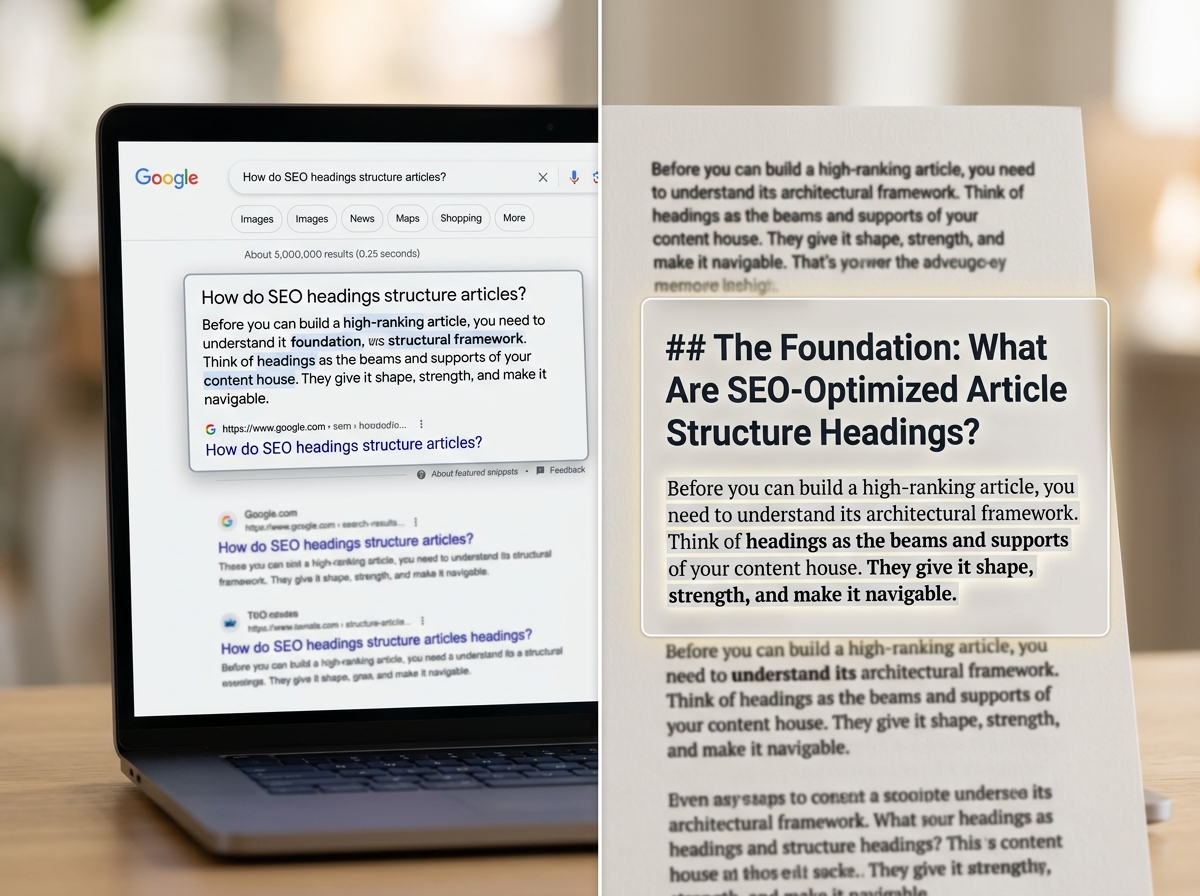
Before you can build a high-ranking article, you need to understand its architectural framework. Think of headings as the beams and supports of your content house. They give it shape, strength, and make it navigable. Without them, your content is just a wall of text—intimidating for users and confusing for search engines.
Decoding HTML Heading Tags (H1-H6)
At their core, headings are simple HTML elements. They range from `
` to ``, each signifying a different level of importance in the content hierarchy:
- H1: The main title of the page. There should only be one.
- H2: The main sections of your article.
- H3: Sub-sections that break down an H2 topic.
- H4-H6: Further sub-sections for highly detailed, long-form content.
- H1: The main title of the page. There should only be one.
- H2: The main sections of your article.
- H3: Sub-sections that break down an H2 topic.
- H4-H6: Further sub-sections for highly detailed, long-form content.
This isn't just about changing font sizes. Each tag sends a specific signal to search engines about how your content is organized and which points are most critical.
The Dual Power: Why Headings Serve Both Users and Search Engines
Optimizing your headings is a rare win-win in SEO. You are simultaneously improving the experience for human readers and providing clear instructions for search engine crawlers. For users, headings act as signposts, allowing them to scan the page and jump to the section most relevant to their needs. For search engines, headings provide context, helping them understand the relationship between different pieces of information on the page.
Beyond Keywords: Headings as a Blueprint for Content Quality
A strong heading structure is a direct reflection of a well-researched article. When you can lay out your topic in a logical sequence of H2s and H3s, it shows that you have a deep understanding of the subject matter. This structural clarity is a powerful, often overlooked, signal of high-quality content that search algorithms are increasingly designed to reward.
The Unseen Advantage: How Headings Drive Readability and User Experience
In the digital world, attention is the most valuable currency. A poor user experience is the fastest way to lose it. SEO-optimized article structure headings are your first line of defense against high bounce rates and low engagement, directly impacting how users perceive and interact with your content.
Guiding Your Readers: Enhancing Scannability and Comprehension
Studies show that most online readers don't read word-for-word; they scan. They look for keywords, phrases, and headings that catch their eye. A well-structured article with clear, descriptive headings allows them to do this effectively. By breaking up long blocks of text, you reduce cognitive load and make your information more digestible, which encourages visitors to stay longer and absorb more of your message.
The Accessibility Imperative: Making Content Inclusive with Proper Headings
Accessibility is no longer an optional extra; it's a core component of good web design and ethical SEO. Users with visual impairments often rely on screen readers to navigate websites. These devices use the HTML heading structure to announce the sections of a page, allowing the user to skip to the relevant part. Using headings for their intended structural purpose—not just for styling—ensures your content is accessible to everyone.
Reducing Bounce Rates: Keeping Readers Engaged Longer
When a user lands on your page from a search query, they want to know they're in the right place—fast. Your H1 and subsequent H2 headings should immediately confirm that your article will solve their problem or answer their question. This immediate validation keeps them on the page. As they scroll, the logical flow created by your headings keeps them engaged, guiding them deeper into the content and significantly increasing dwell time, a key behavioral signal for search engines.
Building Your Content Hierarchy: A Deep Dive into H1, H2, and H3 Tags
Understanding the theory is one thing; applying it is another. Mastering the hierarchical use of H1, H2, and H3 tags is the practical skill that separates amateur content from professional, high-ranking articles. Let's break down the specific role of each primary heading tag.
The Singular Power of H1: Crafting Your Article's Main Title
Your H1 tag is the single most important heading on the page. It's the title of your article and should be treated as such. Follow these non-negotiable best practices:
- Use Only One H1 Per Page: Multiple H1s can confuse search engines about the page's primary topic. Your content management system (CMS) like WordPress usually handles this automatically by making the post title the H1.
- Include Your Primary Keyword: Your main target keyword should appear in the H1, preferably near the beginning. This sends the strongest possible relevance signal to Google.
- Make It Descriptive and Compelling: The H1 should accurately reflect the content of the page and entice the user to read on. For example, instead of "Article Headings," use "A Guide to SEO-Optimized Article Structure Headings."
Segmenting Your Story: Effective Use of H2s for Major Sections
If the H1 is the book title, H2s are the chapter titles. They break your main topic into its core components. H2s should cover the main subtopics a user would expect to find in an article about your primary keyword. For this article, our H2s cover topics like "What Are Headings?", "Building Your Hierarchy," and "Strategic Keyword Integration." Each H2 should represent a distinct, significant idea.
Adding Granularity: Leveraging H3s for Detailed Subtopics
H3 tags are used to further break down the topics introduced in your H2s. They add depth and detail, allowing you to elaborate on specific points without creating a new major section. For example, under the H2 "Building Your Content Hierarchy," we use H3s for "The Singular Power of H1," "Effective Use of H2s," and so on. This creates a clean, logical, and easy-to-follow structure.
When to Go Deeper: A Note on H4-H6 Tags
For most articles, you'll rarely need to go beyond an H3. However, for extremely long, technical, or complex guides (think ultimate guides or in-depth documentation), H4, H5, and H6 tags can provide further levels of organization. Use them sparingly and only when necessary to maintain a clear hierarchy within a detailed H3 section.
Strategic Keyword Integration: Optimizing Headings for Search Engines
While user experience is paramount, you can't ignore the "SEO" in SEO-optimized headings. Integrating keywords strategically into your heading structure is essential for signaling relevance to search engines. The key is to do it naturally, focusing on intent and context.
Primary Keywords in H1: Setting the Main Topic
As mentioned, your H1 is the prime real estate for your primary keyword. This is the clearest signal you can send to Google about the page's core focus. It aligns your content directly with the user's search query from the very beginning.
Expanding Your Reach: LSI Keywords in H2s and H3s
Your H2s and H3s are the perfect places to incorporate secondary keywords and Latent Semantic Indexing (LSI) keywords—terms and phrases that are contextually related to your main topic. For an article on "seo-optimized article structure headings," LSI keywords might include "heading tags seo," "content hierarchy," "improve readability," and "h1 optimization." Sprinkling these throughout your subheadings helps Google build a more comprehensive understanding of your content's depth and relevance.
The Art of Natural Language: Avoiding Keyword Stuffing
The goal is to be strategic, not robotic. Forcing your exact keyword into every heading is a practice known as keyword stuffing, and it's a one-way ticket to a poor user experience and potential SEO penalties. Your headings should always read naturally and make sense to a human. Use variations, synonyms, and question-based phrasing.
Pro Tip: Read your headings aloud. If they sound awkward or repetitive, they likely are. Prioritize clarity and natural language over forced keyword density. Google's algorithms are sophisticated enough to understand context and synonyms.
Answering Intent: Crafting Question-Based Headings
Many search queries are phrased as questions. By structuring some of your H2s or H3s as the very questions your audience is asking (e. g., "Why Are Headings Crucial for SEO?"), you directly address user intent. This strategy not only makes your content highly relevant but also increases your chances of capturing a featured snippet in the search results.
Common Pitfalls and Best Practices for Heading Structure
Knowing the rules is half the battle. Avoiding common mistakes is the other half. Many businesses produce great content that fails to rank simply because of easily correctable structural errors. Here are the critical do's and don'ts.
The Hierarchy Rule: Never Skip a Heading Level
This is the most common technical mistake. You should never jump from an H2 to an H4, skipping the H3. This breaks the logical structure for both search engines and screen readers. Always follow a sequential order: H1 → H2 → H3 → H4.
Function Over Form: Headings Are Not Just for Styling
Never use heading tags simply to make text bigger or bold. That's what CSS (Cascading Style Sheets) is for. Using an H2 for a short phrase you want to emphasize disrupts the semantic structure of your page. Use heading tags exclusively for outlining and organizing your content.
Clarity is King: Avoiding Vague or Duplicate Headings
Headings like "Introduction," "More Info," or "Conclusion" are missed opportunities. They are not descriptive and provide zero SEO value. Instead, use descriptive headings that include relevant terms and accurately reflect the content of the section. Likewise, avoid using the exact same heading text for multiple sections, as this can create confusion.
The E-E-A-T Connection: Headings as Signals of Expertise
Your heading structure is a direct signal of your content's thoroughness, which ties directly into Google's E-E-A-T (Experience, Expertise, Authoritativeness, Trustworthiness) guidelines. A logical, comprehensive outline that covers a topic from foundational concepts to advanced strategies shows that you are an expert. It proves you've done the research and are presenting it in a structured, authoritative way.
Unlocking Advanced SEO: Headings for Featured Snippets and AI Visibility
A solid heading structure doesn't just help you rank in the traditional blue links. It positions your content to win in the evolving landscape of AI-driven search, including featured snippets, "People Also Ask" boxes, and AI Overviews.
Structuring for Quick Answers: Winning Featured Snippets
Featured snippets (or "answer boxes") often pull content directly from a webpage to answer a user's query at the top of the search results. You can optimize for these by:
- Using Question-Based Headings: Frame an H2 or H3 with a common question related to your topic.
- Providing a Direct Answer: Immediately following the heading, provide a concise, clear paragraph, list, or table that directly answers the question.
This structure makes it incredibly easy for Google to extract your content as the best possible answer.
Conversational Search: Optimizing Headings for Voice and AI Queries
As voice search and AI assistants become more prevalent, users are searching with longer, more conversational queries. Your heading structure can help you capture this traffic. By thinking about the natural language questions your audience might ask and using them as headings, you align your content with how people actually talk and search, making it more likely to be surfaced by AI-powered search tools.
The Future of Search: How AI Interprets Your Article Structure
Google's AI and large language models (LLMs) don't just read keywords; they parse structure to understand context and relationships. A clean heading hierarchy is like a well-annotated textbook for these AI systems. It helps them quickly identify the key concepts, supporting details, and overall narrative of your article, making your content a more reliable and authoritative source for AI-generated summaries and answers.
From Concept to Outline: Building Your SEO-Optimized Article Structure
A high-ranking article is built before a single paragraph is written. The outlining stage is where you lay the foundation for success. A strategic outline, built around SEO-optimized headings, is your roadmap to comprehensive, user-focused content.
Step-by-Step Guide to Manual Outlining:
- Understand Search Intent: Start by analyzing the current top-ranking pages for your target keyword. What questions are they answering? What topics do they cover? Look at the "People Also Ask" and "Related Searches" sections on the SERP for clues.
- Map Out Main Topics (H2s): Based on your research, identify 5-8 major themes or questions that must be addressed. These will become your H2 headings.
- Flesh Out Subtopics (H3s): For each H2, brainstorm 2-4 supporting points, details, or steps. These will form your H3 headings.
- Integrate Keywords: Review your outline and look for natural opportunities to place your primary, secondary, and LSI keywords in the headings you've drafted.
Leveraging AI for Efficient Outline Generation
While manual research is effective, it's incredibly time-consuming. This is where modern AI tools can provide a significant competitive advantage. For example, platforms like BestSEOArticles automate this entire process. By simply providing a keyword, the AI performs a real-time analysis of the top-ranking competitors, identifies common themes and content gaps, and generates a perfectly structured, SEO-optimized outline in minutes. This ensures your article is comprehensive from the start without the hours of manual SERP analysis.
Expert Insight: The best outlines are not just a list of topics; they are a strategic response to what is already ranking and what users are actively searching for. AI-powered competitor analysis gives you this data-driven edge, ensuring you cover every crucial angle for topical authority.
Integrating Internal and External Links Strategically
As you build your outline, think about where you can add valuable internal and external links. Plan to link to other relevant articles on your site to build topical clusters and guide users through your content ecosystem. Identify opportunities to cite authoritative external sources to back up claims and enhance your E-E-A-T signals.
Beyond Headings: The Holistic Approach to Article Structure
While headings are the skeleton of your article, other structural elements provide the muscle and connective tissue. A truly optimized article considers every element of its presentation to maximize readability and user engagement.
The Power of Visuals: Images, Alt Text, and Media
Strategically placed images, infographics, and videos break up text and can explain complex concepts more effectively than words alone. Ensure every image has descriptive alt text, which helps with both accessibility and image SEO.
Readability Redefined: Short Paragraphs, Bullet Points, and Lists
Keep your paragraphs short—ideally 2-4 sentences. Use bullet points and numbered lists to present information in a scannable, easy-to-digest format. This makes your content less intimidating and more inviting for the modern reader.
Mobile-First Structure: Ensuring a Seamless Experience
With the majority of web traffic coming from mobile devices, your structure must work on a small screen. Short paragraphs, clear headings, and ample white space are even more critical for mobile readability. Always preview your content on a mobile device before publishing.
Measuring Success: Analyzing the Impact of Your Article Structure
Implementing a proper heading structure isn't a one-and-done task. To understand its impact, you need to track key performance metrics and be prepared to iterate.
Key Metrics: Tracking Rankings, Traffic, and Engagement
After publishing or updating an article with an optimized structure, monitor these key metrics:
- Keyword Rankings: Are you climbing the SERPs for your target and secondary keywords?
- Organic Traffic: Is the article attracting more visitors from search engines?
- Time on Page / Dwell Time: Are users spending more time reading your content?
- Bounce Rate: Are fewer users leaving your site immediately after landing on the page?
Utilizing Analytics Tools for Performance Insights
Tools like Google Search Console and Google Analytics are invaluable. Search Console can show you which queries your article is ranking for and its average position. Google Analytics can provide detailed insights into user behavior, such as time on page and bounce rate, helping you correlate your structural changes with improved engagement.
BestSEOArticles: Your AI Partner for Flawless Article Structures
Crafting the perfect SEO-optimized article structure headings requires research, strategy, and a deep understanding of search intent. While the principles are straightforward, the execution can be a major bottleneck for busy founders and small teams. This is precisely the challenge BestSEOArticles was designed to solve.
Real-Time Competitor Analysis for Superior Outlines
Instead of you spending hours manually sifting through top-ranking articles, our AI does it in seconds. It analyzes the structure, headings, and key topics of the current winners on Google to engineer an outline that is designed to be more comprehensive and competitive from the outset.
AI-Powered Content Gap Identification for Comprehensive Coverage
Our platform doesn't just copy what's working; it identifies what's missing. The AI pinpoints content gaps and unanswered questions in competitor articles, ensuring your content covers the topic more thoroughly, establishing greater topical authority and satisfying user intent more completely.
From Keyword to Publish-Ready: Generating Optimized Articles in Minutes
BestSEOArticles goes beyond just the outline. It can generate a full, publish-ready draft complete with a flawless heading hierarchy, strategic keyword placement, and even AI-generated images. It's an end-to-end solution that transforms a single keyword into a high-ranking asset, freeing you to focus on growing your business.
Future-Proofing Your Content: Adapting to the Evolving SEO Landscape
Search algorithms are in a constant state of flux. However, the principles behind a good article structure are timeless because they are rooted in serving the user. To future-proof your content, focus on the fundamentals.
Prioritizing User Value in Every Heading
Always ask: Does this heading help the user? Does it accurately describe the content that follows? Does it make the page easier to navigate? As long as your primary goal is to provide a clear, valuable, and accessible experience for your reader, your content will remain resilient to algorithmic changes.
Staying Ahead: Embracing AI and Algorithmic Changes
The rise of AI in search isn't a threat; it's an opportunity. Search engines are getting better at understanding high-quality, well-structured content. By embracing best practices and leveraging smart AI tools to create superior content efficiently, you position yourself to thrive in the next era of SEO.
Frequently Asked Questions about Article Headings
How many H2 headings should an article have?
There's no magic number. The quantity of H2s should be determined by the topic's complexity and the search intent. A typical blog post might have 4-8 H2s, while a comprehensive guide could have 15 or more. Focus on covering the topic thoroughly rather than hitting an arbitrary number.
Can I use my keyword in more than one heading?
Yes, but do it naturally. It's essential to have your primary keyword in the H1. You can use it or close variations in one or two H2s if it makes sense. Avoid forcing it into every heading, which can look spammy and harm readability.
Is it bad to have very long headings?
Headings should be concise yet descriptive. While there's no strict character limit, overly long headings can be difficult to read and may get truncated in some views. Aim for clarity and try to keep them to a reasonable length—ideally under 70 characters.
Does changing my heading structure affect my current rankings?
Yes, it can. If your page is already ranking, changing the heading structure can cause temporary fluctuations. However, if you are improving a poor or non-existent structure, the long-term impact should be positive as you improve readability, accessibility, and contextual signals for search engines.
Conclusion: Build Your Next High-Ranking Article
Mastering SEO-optimized article structure headings is not a technical chore; it's a fundamental strategy for creating content that resonates with both people and search engines. By building a logical hierarchy with H1, H2, and H3 tags, you make your content more readable, accessible, and authoritative.
You strategically guide search engines to understand your expertise, positioning your articles to rank higher, capture featured snippets, and drive meaningful organic traffic. This structure isn't just about organizing text—it's about building a foundation for sustainable SEO success.
If you're ready to stop guessing and start creating perfectly structured, high-ranking content with unparalleled efficiency, it's time to see what AI can do. Explore how BestSEOArticles can generate your next SEO-optimized article and take your content strategy to the next level.
Generate SEO articles with AI
Publish SEO content built on real competitor analysis, ready for your CMS.
Buy →