Editorial Policy
Your editorial policy is the instruction set BestSEOArticles uses every time it generates an outline or article for a project. It keeps outputs consistent, on-brand, and much easier to publish without heavy rewriting.
After you create a project, BestSEOArticles sends you directly into the policy flow. You can save a basic version quickly and improve it over time, but even a lightweight policy usually improves output quality immediately.
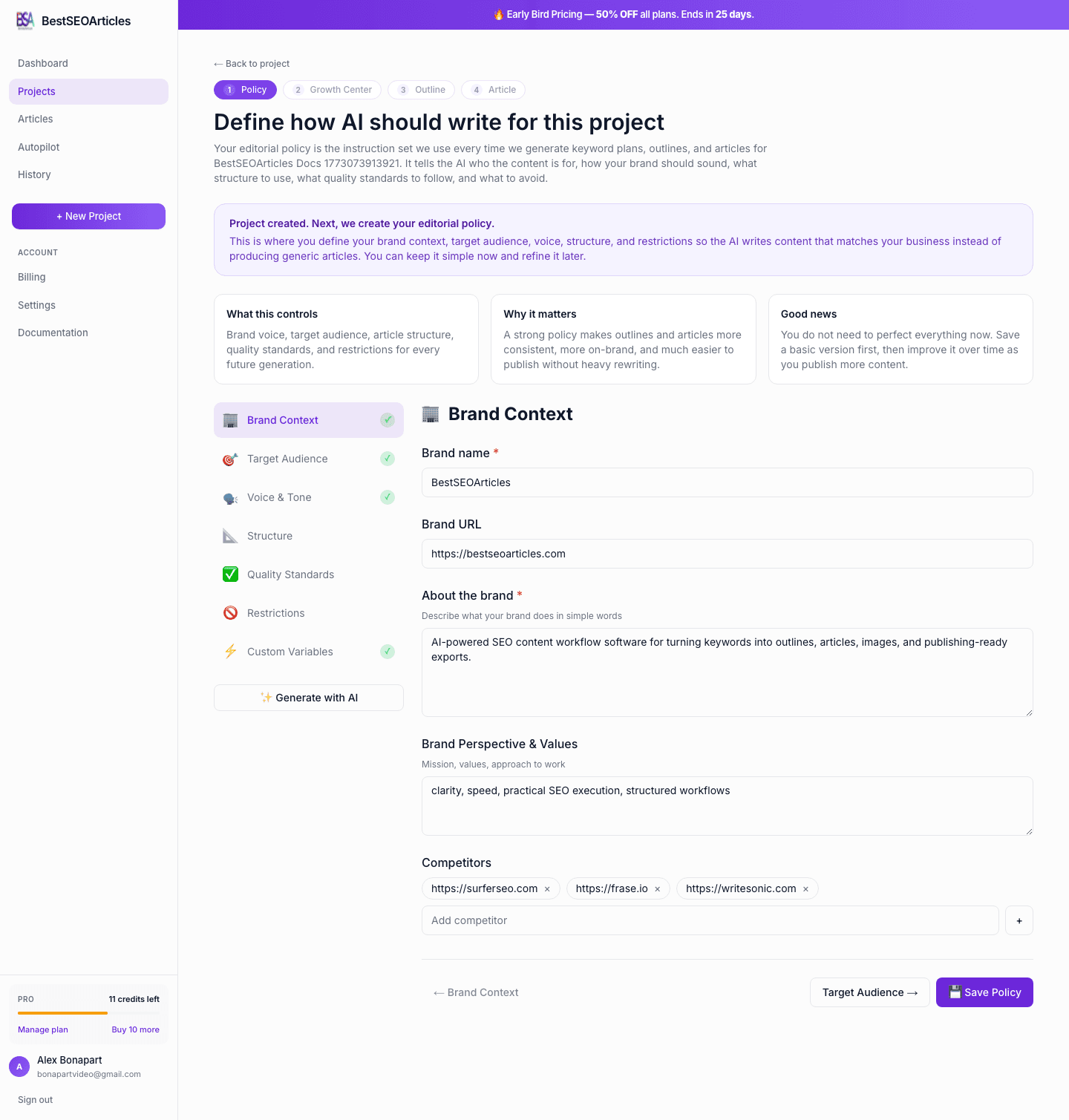
What the policy controls
- Brand identity, who the content represents, what the business does, and how it should be framed.
- Target reader, audience sophistication, use cases, pain points, and industry context.
- Voice and tone, whether content should sound authoritative, conversational, analytical, practical, or custom.
- Structure, heading style, paragraph rhythm, and preferred content format.
- Quality rules, evidence expectations, E-E-A-T guidance, and source handling.
- Restrictions, banned words, forbidden topics, compliance notes, and brand limitations.
- Reusable variables, placeholders that help the AI mention recurring business details consistently.
Core policy areas to define
Brand context
This is where you define brand name, website, brand description, values, industry, and any competitor URLs that matter. Strong brand context gives the AI a reliable frame of reference instead of forcing it to generate generic content.
Target audience
Describe who the content is for. Include skill level, role, stage of awareness, and the kind of outcomes they care about. This helps the AI pick the right vocabulary, examples, and depth.
Voice, tone, and perspective
Choose the tone you want the product to maintain across content. For example, expert and authoritative works well for B2B and technical content, while practical and advisory may fit service businesses and implementation guides.
Structure preferences
Use this area to standardize heading style, paragraph length, and formatting preferences. This is particularly useful if you want all generated pieces to feel like they came from one editorial system instead of from disconnected prompts.
Quality standards
BestSEOArticles uses the policy to guide evidence level, sourcing expectations, and E-E-A-T direction. If your niche requires stronger authority, citations, or more careful claims, define that here so the system treats it as a default rule, not a one-off request.
Restrictions
This is where you protect the brand. Add banned phrases, topics to avoid, regulatory concerns, or style constraints that should never be violated in generated content.
Custom variables
Use variables for recurring brand assets such as CTA copy, company name variants, short proof points, offer descriptions, or support details. This reduces repetition and keeps brand mentions consistent across future articles.
Using AI to bootstrap a policy
If you do not want to fill everything manually, use the AI generation option on the policy page. This is useful when you already have a website or enough source material to infer your brand setup.
- Open your project’s Editorial Policy page.
- Choose the AI generation option.
- Provide your brand name and website URL.
- Optionally add supporting URLs such as About pages or known competitor URLs.
- Generate the draft policy.
- Review every section and tighten anything that should be more explicit.
- Save the policy before moving into outlines or articles.
How editorial policy affects the rest of the product
| Area | Policy impact |
|---|---|
| Outline generation | Influences tone, structure preferences, angle selection, and how sections are framed. |
| Article generation | Controls voice, audience fit, promotional framing, linking behavior, and restrictions. |
| Brand mentions | Helps the system promote your business more naturally when promotion is enabled. |
| Publishing readiness | Reduces cleanup work in the editor because more decisions are made upfront. |
Best practices
- Be explicit about audience sophistication. It changes vocabulary and content depth.
- Write real restrictions. If the brand must avoid hype, medical claims, or compliance-sensitive language, state it directly.
- Use examples. A few concrete preferences usually outperform vague direction.
- Iterate after the first article. The best time to improve policy is after reviewing one real output.
Next step
Once your policy is saved, continue to Generating Outlinesto build the article blueprint for your first keyword.